 Dodgers Digest Los Angeles Dodgers Baseball Blog
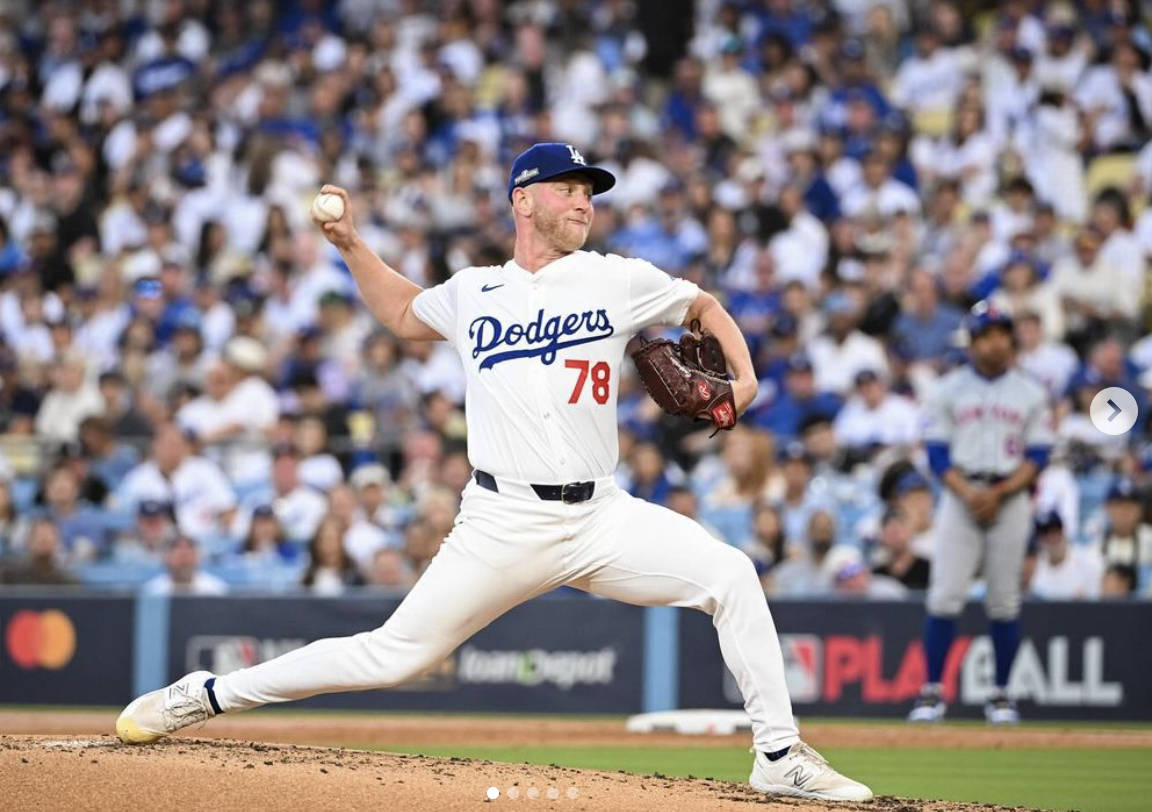
In a world in which the Dodgers have the likes of Tyler Glasnow, Shohei Ohtani, Roki Sasaki, Emmet Sheehan, Blake Snell and 2025 World Series MVP Yoshinobu Yamamoto, could another pitcher emerge in 2026?
The breakout candidate pitcher, you ask? Ben Casparius.
Casparius, 27 in February, was the Dodgers’ 5th-round selection in the 2021 MLB Draft. He debuted in 2024 and logged 6 1/3 innings in their 2024 championship run. He’s coming off a solid season in limited time. He had a 4.64 ERA, which, admittedly, isn’t great. However, when you drill down, his expected stats and other peripherals stand out:
- 3.56 xERA
- 3.57 FIP
- 100 DRA-
- 15.0 K-BB%
- 87.5 MPH EVA
- 31.9 HardHit% (Top 3% in MLB)
Those are numbers that should pique anyone’s interest. If the Dodgers had room for him the rotation, he’d be an even more interesting arm going into next season.
Stuff+ likes his repertoire, too. By the metric, every one of Casparius’ pitches improved from 2024 to 2025, with his 4-seam fastball taking the biggest step forward.
Having noted that, let’s take a look at his arsenal to see why he might be primed for a breakout in 2026.
——
4-Seam Fastball
Casparius’ fastball averaged 96.1 MPH with an average spin rate of 2,435 RPM — not that dissimilar to Sheehan (2,444) and Justin Wrobleski (2,422). While his spin efficiency is closer to Wrobleski rather than the elite Sheehan, the result for Casparius is a similar IVB to Sheehan (17.9″, just short of elite), regardless. Additionally, Casparius’ velocity increased from 2024 by 0.5 MPH and his spin rate by 32 RPM. He gave up a little too much slug on it (.537), but his 33.3% whiff rate on it would have been 4th-best on the Dodgers among qualified pitchers.
Despite giving up six home runs on his heater, Casparius did a good job of not living in the strike zone with his fastball.
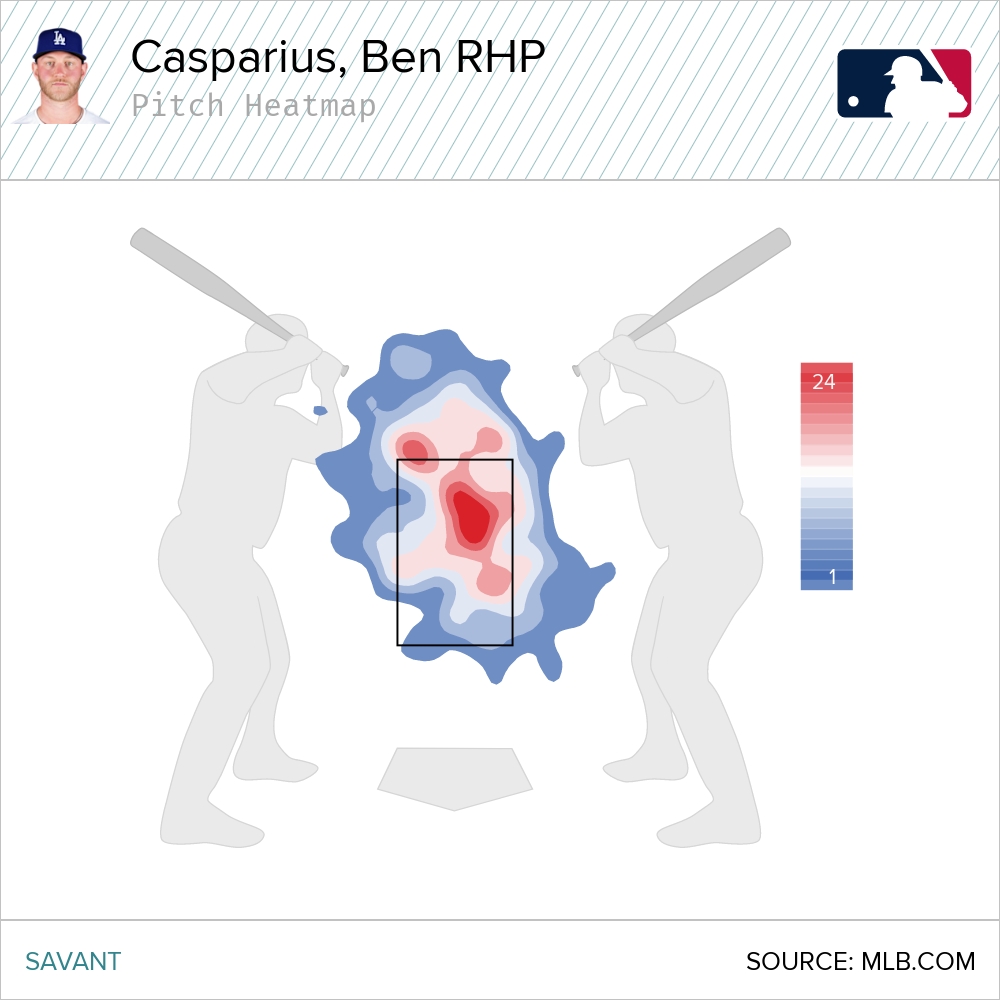
Five of the six homers he gave up on his fastball were in the strike zone. Conversely, he got 26 swinging strikes on his fastball on pitches outside of the strike zone. That translated to a 2.1% swinging strike rate outside the zone on his 4-seamer, behind Sheehan (3.4%), Will Klein (3.3%) and Alex Vesia (2.4%). Sheehan and Vesia have similar spin rates to Casparius’ fastball, while Klein’s was more than 200 RPM less. The typical rule with spin rate, IVB and velocity are the higher they are the more whiffs a pitcher will generate. This is why Casparius, Sheehan and Vesia all have above-average whiff rates on their 4-seamers.
Ben Casparius blows a 98 MPH fastball by Manny Machado and gets a nod of approval from Manny. pic.twitter.com/kwcLRLNogk
— Jacob Brownson (@brownsonjacob2) June 11, 2025
What’s funny about this sequence is Casparius had perfectly placed fastball to get Machado, as shown above. Five days later, Machado would take Casparius deep on almost the same pitch.
SDP – Manny Machado Solo HR (11)
— MLB Home Runs🚀 (@MLBHRs_) June 17, 2025
📏 Distance: 353 ft
💨 EV: 99.9 mph
📐 LA: 35°
⚾️ 96.2 mph four-seam fastball (LAD – RHP Ben Casparius)
🏟️ Would be out in 23/30 MLB parks
SDP (3) @ LAD (6)
🔺 6th#ForTheFaithful pic.twitter.com/GFwY7eKp7C
Difference here is, Casparius’ fastball was 1.8 MPH slower yet had a spin rate of 134 RPM more than the one just five days ago that induced a swinging strike. Just baseball, in a nutshell.
This doesn’t necessarily have anything to do with the entirety of this article, I just thought it was a funny footnote.
Sweeper
His most-used pitch in 2025 was his sweeper. He threw it 32.2% of the time and had an average spin rate of 3,080 RPM — trailing Dustin May‘s 3,194 RPM. However, it didn’t produce as many whiffs as you might expect. His 25.9% whiff rate was worse than May’s 28.3%, and lack of whiffs had long since been an issue for May.
Of pitchers who threw at least 100 sweepers and had a spin rate of better than 3,000 RPM, Casparius’ whiff rate was the second-worst. All eight pitchers who fall into that criteria held hitters to an average exit velo of 86.5 MPH, with Casparius checking in with an above-average mark of 85.8 MPH. For him, it’s more of a soft-contact offering than a swing-and-miss offering — which isn’t a bad thing, considering his fastball (as we’ve already seen) and curveball (stay tuned). His 22.7% HardHit% was the second-best in baseball (behind Clarke Schmidt‘s 22.2%) on sweepers that averaged more than 3,000 RPM.
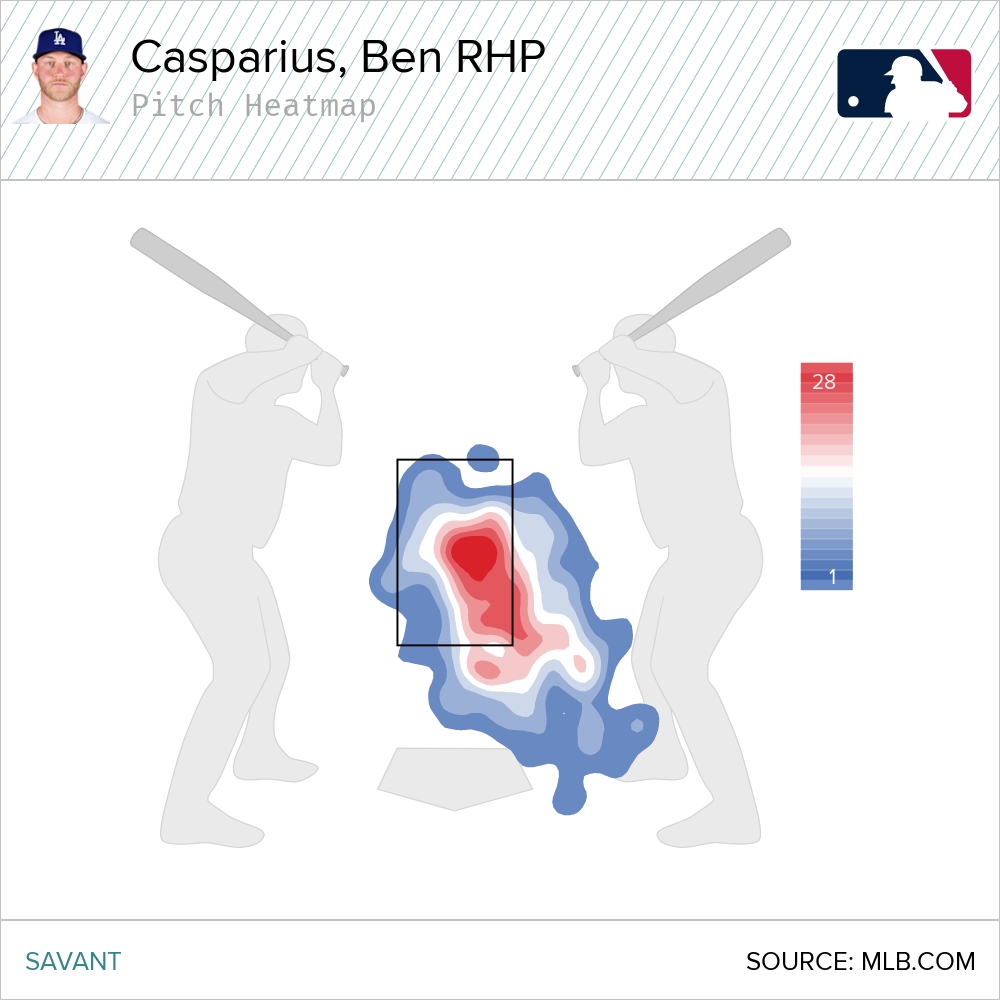
Casparius lived on the outer-half (to righties) and inner-half (to lefties) with the sweeper. The heatmap looks that way because he threw sweepers to righties 6.25 times more than he did to lefties. It was his second-best pitch when it came to inducing soft contact and his best when it came to expected wOBA (.262).
Ben Casparius, Wicked 3237 RPM Slider. 🌪️ pic.twitter.com/dX28CjBUEZ
— Rob Friedman (@PitchingNinja) April 27, 2025
If he could be more consistent at getting whiffs on it, he could jump to another level as a pitcher, and it could be a matter of improving command since the pitch itself is above-average. For now, inducing weak contact will have to do.
Cutter
His cutter made the biggest leap of all, as he went from throwing seven total (4.5%) in 2024 to using it 21.8% of the time (275 pitches) in 2025.
And again, spin is the name of the game. Casparius’ cutter averaged 2,755 RPM — fifth-highest in MLB (minimum 100 cutters thrown). Also much like his sweeper, his cutter does a good job of inducing weak contact rather than accumulating whiffs. It was his best pitch at doing so, averaging 83.0 MPH on batted ball and just a 19.0% whiff rate. His 22% hard-hit rate was the best among pitchers with 2,700 RPM or higher cutters. His whiff rate was second-worst, well behind Brandon Pfaadt‘s 10.2%. When you consider guys like Corbin Burnes and Sonny Gray ran 51.6 and 44.4 HardHit% on their cutters, seeing Casparius be at half (or better) of that is downright impressive, and it’s why it was by far his most effective pitch by run value.
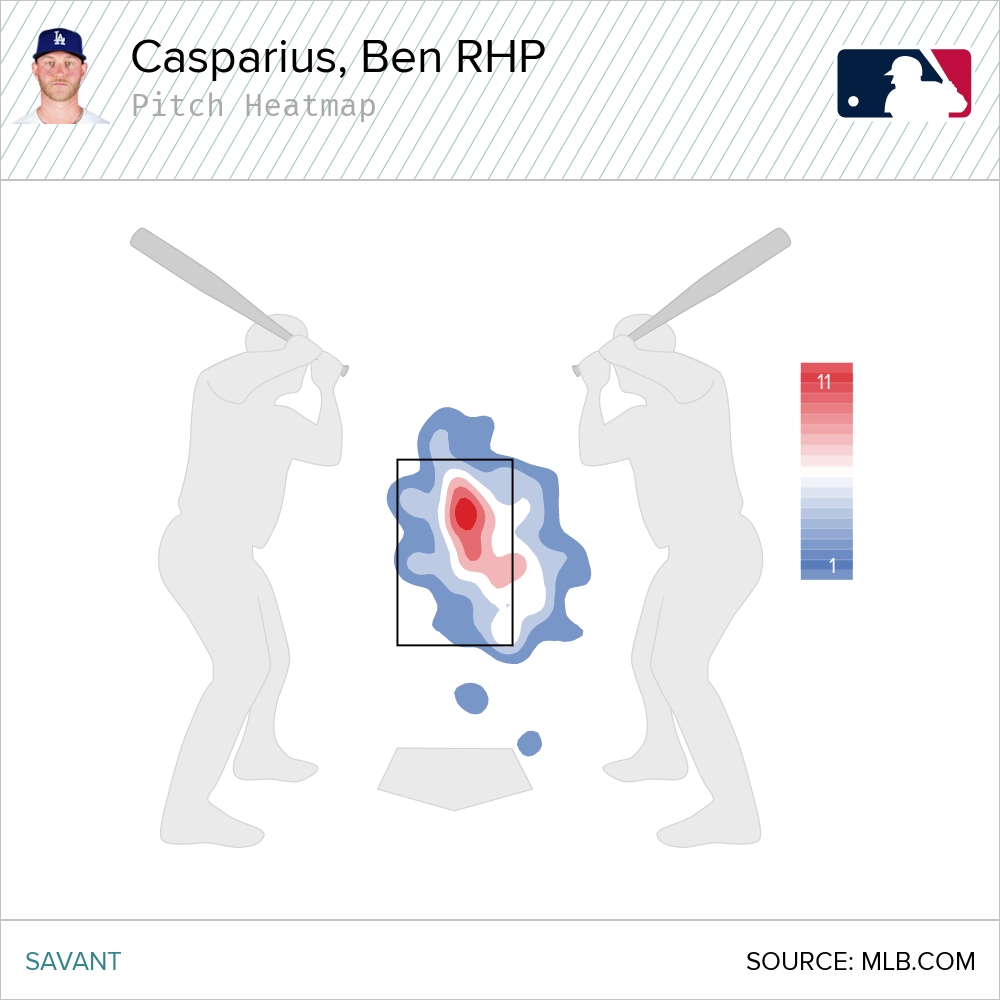
He definitely lived more in the strike zone with it, and was still able to induce weak contact on a consistent basis. He threw it almost evenly between lefties and righties, but it was much more effective against lefties.
Best Cutter: Ben Casparius Dodgers
— landon (@landonb_bsbl) December 7, 2025
92.1 MPH, 7.0 iVB, 5.4 HB, 2755 RPM, 21.7% Hard-Hit
Runner Up: Cam Schlittler Yankees pic.twitter.com/982SFkY2ly
Three of the 19 hits allowed against his cutter were for extra bases — all doubles — and just one was against a left-handed hitter: Michael Busch. And, let’s be honest, he didn’t exactly tear the cover off the ball.
Ben Casparius strands the bases loaded!
— MLB (@MLB) August 13, 2025
We're heading to extras in Anaheim! pic.twitter.com/zifOkb5hhY
There is, on average, a four MPH difference between his 4-seamer and cutter, so that’s why he can get hitters like Taylor Ward to swing through a seemingly innocuous 91 MPH cutter on the very edge of the strike zone.
Curveball
Finally, we’ve arrived at Casparius’ curveball. It saw a slight increase in usage from his rookie season — up to 14.4% from 10.9%. That’s a little misleading because he threw just 17 in 2024 and 182 in 2025, but if you extrapolate the 2024 numbers, the percentages work.
It’s his primary weapon against lefties, as he threw it 3.5 times more to them than righties. It’s also his second 3,000-plus RPM pitch. While he isn’t Nolan McLean with it, it’s still an effective offering and the best pitch he has at inducing swinging strikes.
His curveball had the sixth-best whiff rate among pitches (again, minimum 100 pitches) in baseball. That’s good! And his 42.4% whiff rate (minimum 80 pitches and 3,000 RPM) against left-handed hitters as a right-handed pitcher was the best in baseball. Granted, there’s a bit of specificity with that statistic, but we’re gonna roll with it.
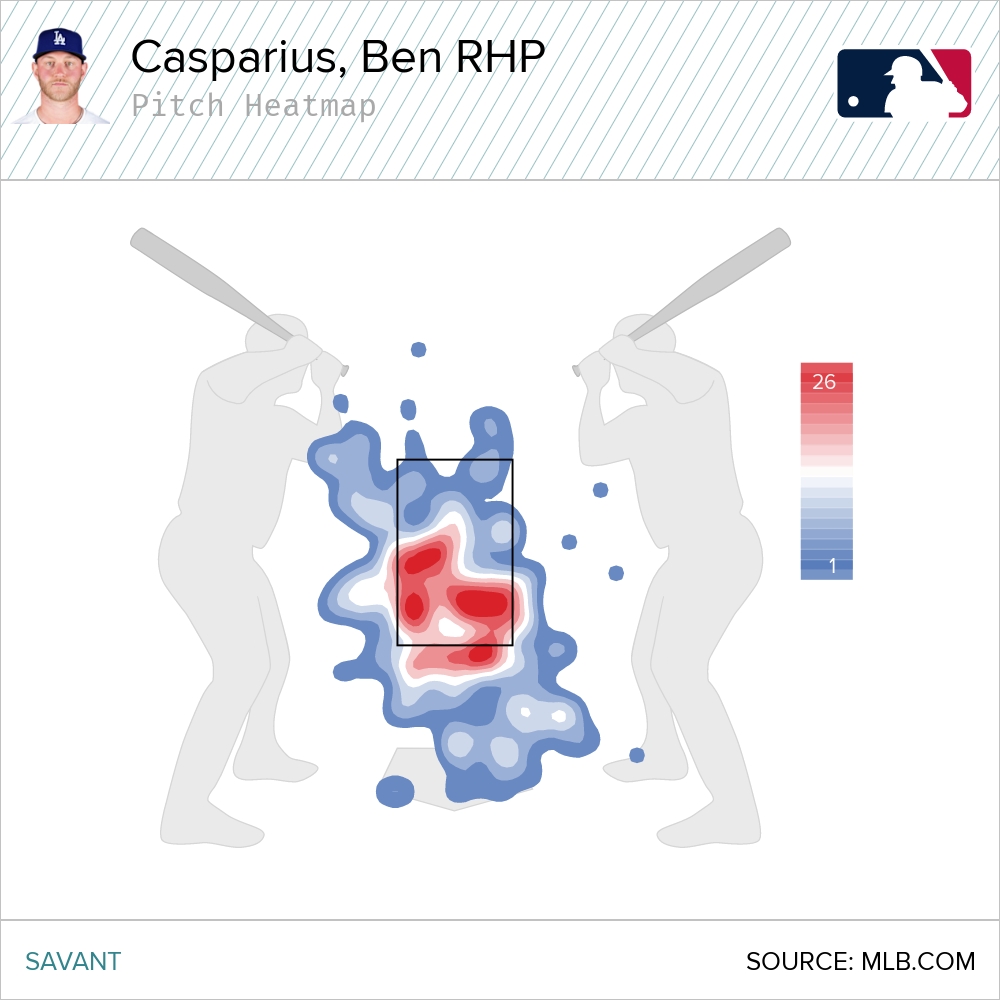
Two things to note here:
- He lives below the zone with the curve. That’s how he induces so many whiffs.
- When he’s in the strike zone with it, it gets hit. Hard.
Let’s examine that second point.
Casparius’ curveball isn’t great when it comes to limiting hard contact and results of said hard contact. He allowed an average exit velo of 92.6 MPH and a 52.4 HardHit% on it. The results: .273 BAA, .261 xBA, .485 SLG, .343 wOBA. Yes, it’s only 21 batted ball events, but it’s something to keep in mind when evaluating Casparius. However, there is some hope, as his xSLG of .333 and xwOBA of .271 are positives for him. Four of his nine hits allowed went for doubles, and three of those were hit by left-handed hitters with an average 98.9 MPH EV — so, no bloopers. A larger sample size at the same percentage of usage could tell a better story, but we’re working with what we have here.
#Dodgers Ben Casparius with a nasty curveball. pic.twitter.com/IVDEiyoe0I
— Dodgers_After_Duty (@msalas24) April 27, 2025
If he can command the pitch more going forward, that’s another thing that could unlock the next level for Casparius, as the pitch’s metrics reveal a high ceiling.
——
Casparius also throws a sinker, but I use “throws” very loosely. He threw 15 in 2025 (1.2%), all of which were to right-handed hitters. He allowed one ball in play — a 3-1 pitch to Andrew McCutchen that resulted in a ground out. He hit Ramon Laureano with one and got two swinging strikes on it. If you look at his pitch chart, you can see exactly what he wants to do with the pitch.
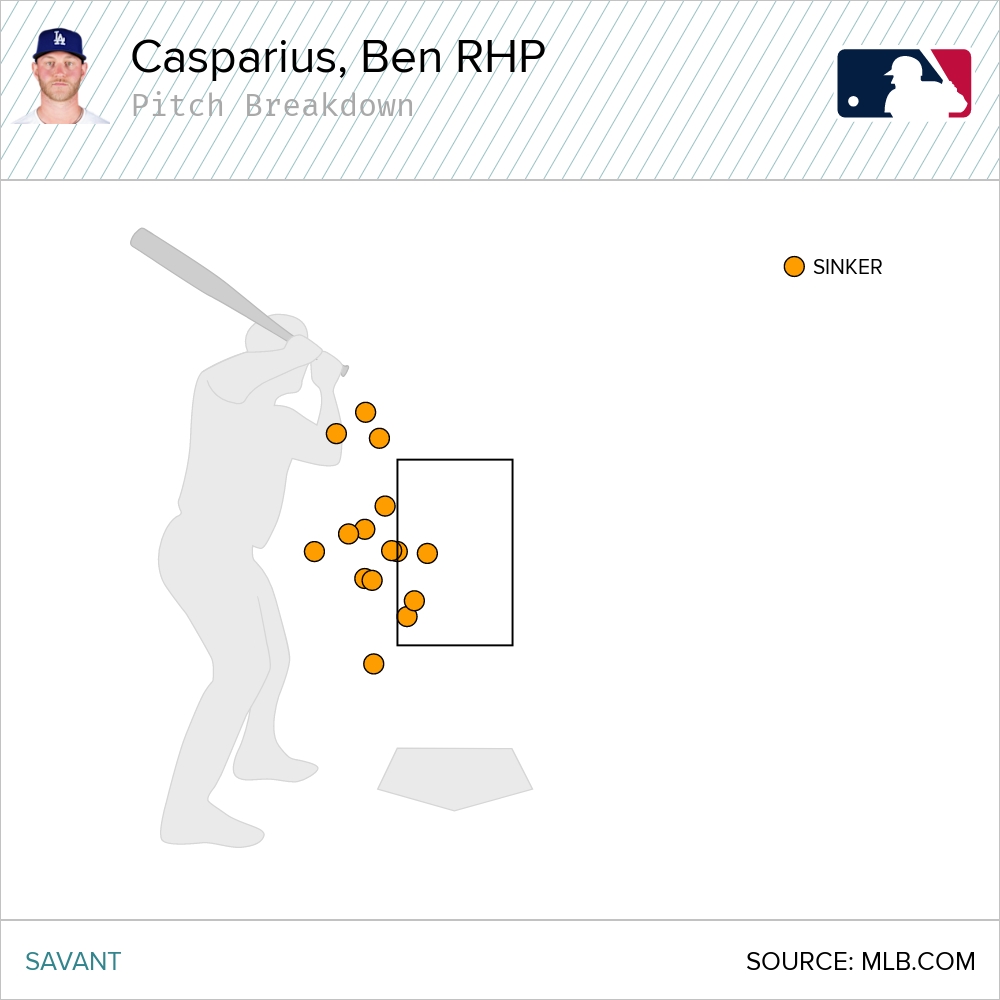
So, he’ll use it conservatively and use it basically one way. Just something to keep in mind when watching him in 2026.
——
When factoring in velocity and pitch movement, one interesting pitcher similarity Casparius has is to Drew Rasmussen of the Rays. Rasmussen is coming off a season in which he threw 150 innings and posted a 2.76 ERA, 3.43 xERA, 3.84 FIP and a 15.4 K-BB%. Rasmussen is probably the 90th percentile outcome for Casparius if you’re looking strictly at results. It’d be surprising to see Casparius replicate the raw numbers (mostly because of lack of playing time), but if given the opportunity, the pitching profile he possesses could produce results.
Rasmussen’s results in 2025 were better than Casparius’ — which shouldn’t be surprising.
| Player | ERA | FIP | K-BB% | GB% | WHIP |
| DR | 2.76 | 3.84 | 15.4 | 49.3 | 1.02 |
| BC | 4.64 | 3.57 | 15.0 | 33.5 | 1.27 |
| Player | BA | OBP | SLG | wOBA | ISO |
| DR | .210 | .267 | .336 | .266 | .126 |
| BC | .252 | .305 | .408 | 310 | .157 |
However, the delta between Casparius’ expected stats and Rasmussen’s expected stats is in Casparius’ favor.
| Player | BA-xBA | OBP-xOBP | SLG-xSLG | wOBA-xwOBA |
| DR | -.027 | -.025 | -.030 | -.023 |
| BC | .012 | .010 | .027 | .013 |
And Casparius has Rasmussen in Whiff%, EV and HardHit%.
| Player | Whiff% | EV | HardHit% |
| DR | 22.3 | 90.6 | 43.7 |
| BC | 27.7 | 87.5 | 32.2 |
If you could combine the results of Rasmussen with the expected stats and batting against metrics of Casparius, you’d have one of the best pitchers in baseball. But if you’re looking for a guy Casparius could develop into, Rasmussen might be that guy.
——
Of course, all of this is predicated on playing time. Casparius was called upon heavily in the first half, when the Dodgers were dealing with a lot of injuries on the pitching side. He was a bit of an unsung hero in that time, despite a 4.45 ERA. His opportunities were limited in the second half when guys started to get healthy.
A breakout could be on the horizon for the reasons detailed above, but said breakout can’t happen with inconsistent chances. Whether the breakout is as a starting pitcher, long reliever, middle reliever or, least likely, a short reliever, what’s undeniable is Casparius has the talent to not only be a quality MLB pitcher, but he has the talent to be a quality MLB pitcher on a championship-level squad.
If I’m trading with the Dodgers this winter, Casparius is a guy I’m targeting, provided my organization has the ability to continue to develop him and — more importantly — has a runway for him to pitch.
Then again, the Dodgers tend to value this type of arm, so who knows if they’d move him. I’m sure they would in the right deal, but they also aren’t going to give him away. Either way, he has earned a chance to pitch at the MLB level in a full-time capacity. We’ll see if he gets that chance in 2026.
