 Dodgers Digest Los Angeles Dodgers Baseball Blog
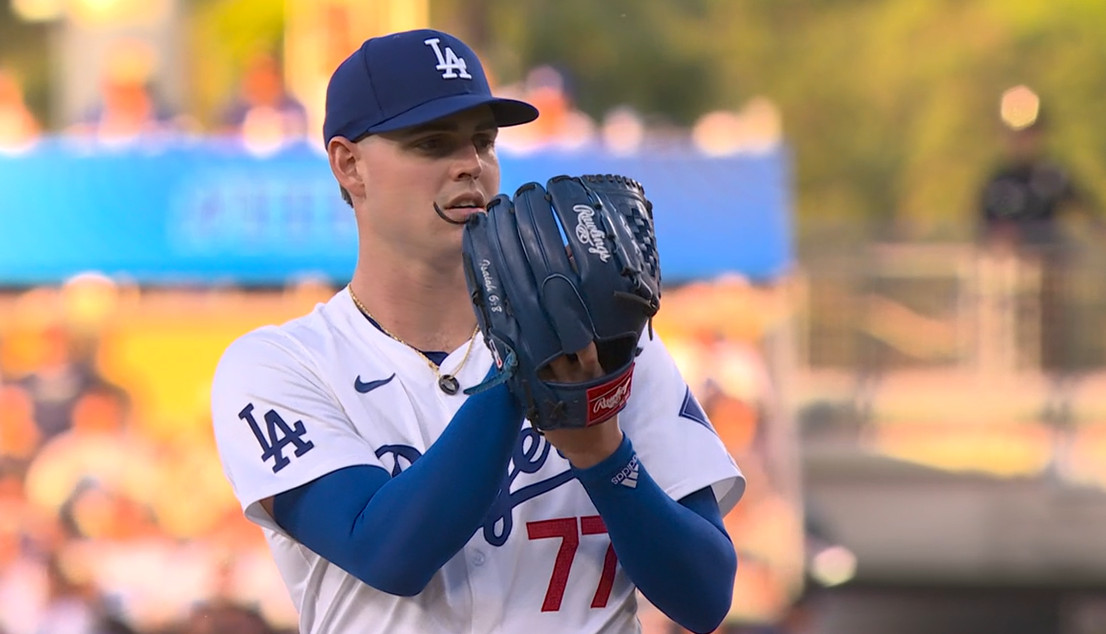
As promised in the last edition of the Roundup, this edition will be primarily focused on prospect stuff and general baseball than the big-league club itself.
Still a lot of writing worth reading, IMO.
======
Dodgers Dugout Live: River Ryan was a guest on the podcast and he spoke about tweaking his mechanics and lifting like crazy during rehab. He doesn’t really look like the lead picture above anymore as a result.
Specifically, Ryan mentioned that he’s sitting 98-100 MPH in live at-bats now (would be up 2-3 ticks) and that he added a new pitch that he says gives him seven. Said pitch will remain a secret until he presumably busts it out in Spring Training, so that’s something to watch for.
Prospect Savant: An all-encompassing profile of Paul Gervase, along with an interview, about his unique stuff and how the Dodgers approached his development.
Pure empowerment. Upon arrival, he was told, “We traded for you because we like how good you are. Now do what you do.”
While everybody envisions player development as some kind of complicated mad scientist formula, a lot of the time it’s simply a team getting a player they like and telling him to do more of the thing they do best.
TJStats: Ching-Hsien Ko was named as the Dodgers’ breakout hitting prospect for 2026.
Ching-Hsien Ko was a notable signing in the 2024 IFA class, securing a comfortable $650,000 bonus from the Dodgers. Both on the surface and in the underlying metrics, Ko’s slugging upside is palpable. At 6’3″ and 215 lb, the 19-year-old flashed encouraging power in the complex league. Although his Lo-A ISO sat at a paltry 0.061, Ko maintained an excellent 17.0 BB% on the season thanks to his ability to lay off outside pitches. Additionally, his contact skills looked better than expected with 23.3 Whiff%. Ko has mostly filled out his massive frame, but if there is any more room for growth, his power potential could be eye-popping.
TJStats: On the mound, it was Christian Zazueta getting the nod.
Christian Zazueta may be the top pitching prospect in the Dodgers system. His combination of strike-throwing ability and electric stuff gives him an extremely high ceiling. His fastball sits 93–94 MPH with 14″ IVB from a 5.2 ft release and an exceptionally shallow -4.3° VAA. It registered a 32.7 Whiff% and 26.3 Z-Whiff% for the season. His slider and changeup complement the fastball to form a prototypical three-pitch starter mix. Zazueta is a name to watch as he looks poised to make a major impact in 2026.
Both guys have been on prospect radars for their raw ability, but really tapping into it in 2026 could see them close in on Top 100 status.
——
Baseball America: The Dodgers have the best Hit+ in the minors.
The Dodgers are pretty much universally acclaimed as player development behemoths and, unsurprisingly, rank at the top of the list. Some of their hitters of note include Mike Sirota (Hit+ of 122), Charles Davalan (116), Josue De Paula (114), Emil Morales (114), Eduardo Quintero (113), Zyhir Hope (112) and Ching-Hsien Ko (112).
Interestingly, the Dodgers rank in the top 10 of every facet of Hit+ except for in-zone contact rate. Kinda tracks with their approach.
Baseball America: The Dodgers also have the best Stuff+ in the minors.
Aidan Foeller (118 STF+, 123 nSTF+) has excellent numbers. As Baseball America identified last week, Foeller ranks in the top 10 for Stuff+ among all pitchers with at least 1,000 pitches tracked, Christian Zazueta (108, 115), Adam Serwinowski (107, 113), Payton Martin (109, 112), Ronan Kopp (112, 110), Nick Frasso (101, 109), and Patrick Copen (110, 104) also stand out.
Seems good.
——
Just Baseball: In what I think is the first Top 100 release of the year, they have six Dodgers on their list, with Zyhir Hope (#19), Josue De Paula (#20), Mike Sirota (#42), Eduardo Quintero (#44), Alex Freeland (#51), and River Ryan (#71) making the cut.
Mostly uncontroversial rankings for the Dodgers here, though still having Hope as their top prospect will likely standout by the end of the releases.
Baseball Prospectus: The Dodgers’ ranking is led by Josue De Paula, and they end up ranking the Top 21 prospects and mention nine others.
2025 third-round pick Landyn Vidourek checks in at #9, and he’s a name I haven’t seen mentioned much yet.
Nobody ranked above Vidourek in this system hit the ball as hard as he did last year. Not even Zyhir Hope. Yes, a lot of that came with ping bats in a relatively down Big12 conference. But he continued to hammer the ball in his pro debut as well. He’s already done a bit of a setup tweak in the pros to create a bit steeper hand load, and while he’s never going to be a contact merchant, he has a loose power stroke with plus bat speed.
Baseball America: Their Top 10 for the Dodgers is led by Eduardo Quintero.
2025 first-rounder (40th pick) Zach Root notably checks in at #8.
Root works with a full four-pitch complement and adds deception thanks to a funky delivery that contains a high leg lift and a three-quarters arm slot. His arsenal is fronted by a sinking fastball in the mid 90s and backed by a potentially above-average curveball and changeup as well as a slider that could be an average pitch. The latter breaking ball features 1-to-7 break and was used against both lefties and righties, and the Dodgers would like to see Root throw his changeup more as a professional than he did in college.
——
The Athletic: A profile on the history of Induced Vertical Break, with Alex Vesia serving as a star of sorts.
“Induced vertical break has always been the second-most important metric (after velocity),” Kalk said. “I don’t know whether some teams got obsessed with spin rate in reality or whether that was just a talking point, but induced vertical break outperforms spin rate in every pitching metric that you want to look at. And I’m free saying that right now because everybody knows that.”
Ten years ago, such analysis was still proprietary; Kalk instructed Rays coaches to say “spin rate” in interviews because he didn’t want other organizations to pick up on Tampa Bay’s true priority. The Rays weren’t chasing spin. They were chasing movement, which doesn’t come from spin alone.
Serves as a great explainer, if nothing else, honestly.
The Athletic: A comprehensive look at how teams evaluate makeup, using Framber Valdez‘s mess as a setup of sorts.
One scouting executive had a three-bucket approach to defining makeup:
“Is there anything that he’s gonna do or has done off the field that’s disqualifying?” he said. “It doesn’t matter how good you are, because you’re not going to be on the field. And then the second bucket is, how is this kid as a player, how competitive is he? How hard does he work? The third bucket is: How is the player as a teammate, and that’s the bucket you typically don’t really get a good feel for until you stick the guy in the right seat.”
When teams consider signing free agents long-term, they have to think about how that player will be received within the team’s clubhouse. Not every player has to get along, but teams don’t want to introduce personalities who will disrupt the flow in a 162-game season. One major-league manager said projecting how a player will fit in a clubhouse might be the most difficult and one of the most important aspects of scouting makeup.
Glad the article also touched on the potential bias from scouts when it comes to something that is so inherently subjective and hard to quantify.
When scouting for makeup, teams have to be aware of their own personal biases, either conscious or unconscious. The interaction of race and culture with scouting has cast a long shadow over player evaluation for much of the sport’s history. Researcher Rob Arthur found that there has been “persistent bias against Black and Latino players since 1950, preventing them from playing at certain positions and rising through the ranks of the minors.” In the study, when judged completely off minor-league headshots, players with darker complexions were sent to the outfield and the infield and catcher positions were historically reserved for players with lighter skin tones.
“The scouts that are the most open-minded and aware of their limitations and biases and are willing and secure enough to ask people who are closer to that culture or that player’s background what they think, they get a more accurate representation of what the player actually is,” said an executive. “And that takes some humility and it takes some recognition that we are different and people act in different ways and sometimes it’s not a negative.”
Overall, just an interesting insider look at things.
