 Dodgers Digest Los Angeles Dodgers Baseball Blog
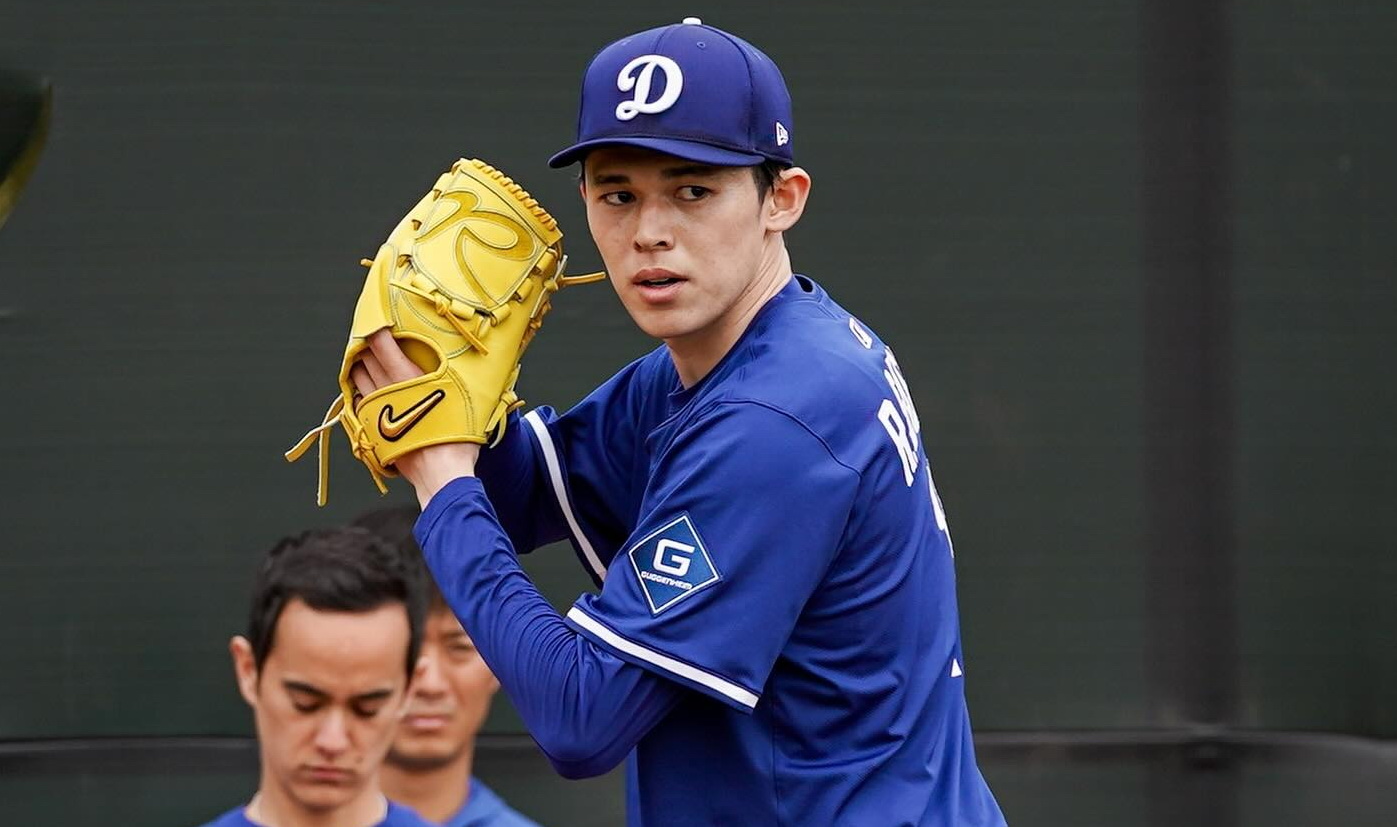
Roki Sasaki had a roller coaster of a rookie campaign — he lost velo, lost command, and lost time on the active roster (due to injury) before roaring back to life as he swapped to relief late in the season, a role in which he eventually became the closer and played a critical part in the Dodgers’ successful title defense. It was a temporary role, as it turns out, as the club shored up the armbarn with the high profile addition of one Edwin Diaz.
Of course, Sasaki was a starter in Japan, he began as a starter here, and, in an interview with Dylan Hernandez of the California Post, Dave Roberts said that the Dodgers would give the lean righty every opportunity to be their fifth or sixth starter. But for The Monster of Reiwa Era to successfully transition back to that role, Roberts said that the 24-year-old still needed to develop a third pitch. Roberts went on to say that, “It’s going to need to be something that goes left.” A tricky proposition, considering: A) Sasaki does not spin the ball exceptionally well, and B) attempts at developing his slider contributed to a lower arm angle which messed up his mechanics and caused a drop in fastball velocity.
When Sasaki was doing his rehab assignment with Oklahoma City, he did in fact pursue development of a pitch that “goes left,” working on a cutter, an offering he threw 21 times before shelving it to be a two-pitch reliever. So what about this cutter, and what can we glean, if anything, from the little he threw it? Let’s find out.
——
To start things off, this is a cutter Roki threw for Triple-A Oklahoma City on Sept. 9, in what would be his final start of the season:
At first glance, hey, not bad. Looks a little slider-y, it isn’t the typical horizontal (or even rising) cutter, and most importantly, it got a whiff. The characteristics of the cutter he threw with OKC: it averaged 90.5 MPH, spun at a clip of 1,919 RPM, averaged 0.46 inches of glove side movement, and had 2.74 inches of rise.
Now here is where I deploy my first bit of foolishness, as mucking with such small samples is an often fruitless endeavor, but I’m working with I’ve got, so here goes.
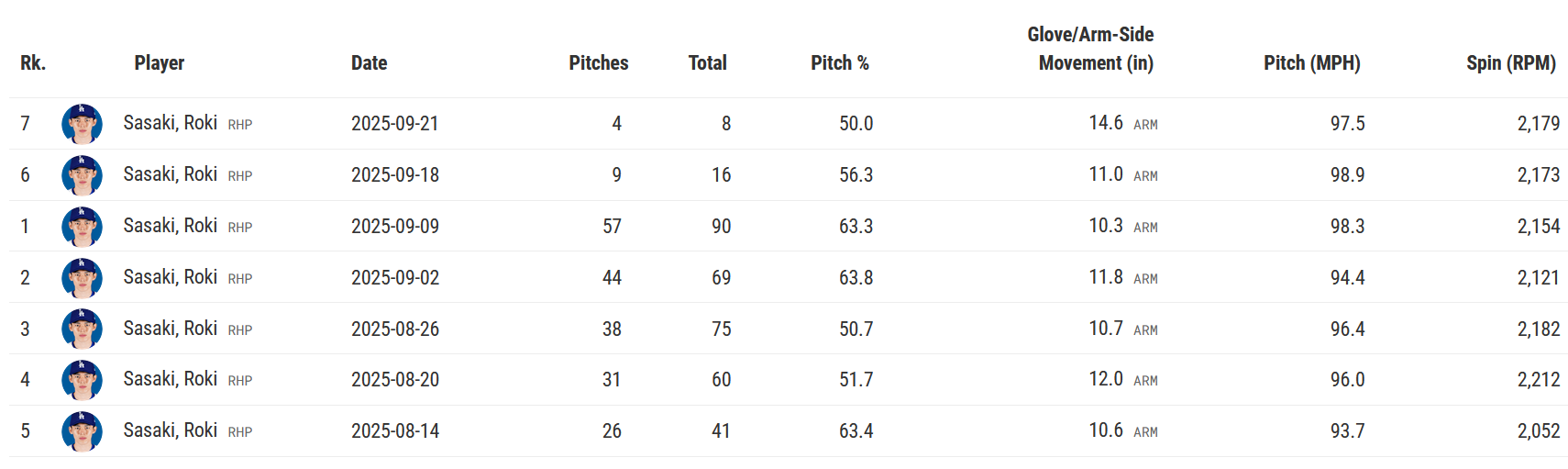
Looking at these pitches in order, Sasaki’s average fastball velo ramped up significantly as he neared his recall to the big club, going from a nadir of 93.7 MPH on Aug. 14 to a peak average of 98.3 in his last start of the season on Sept. 9 (the 18th and 21st were relief appearances; I am looking at pitch characteristics from starts only).
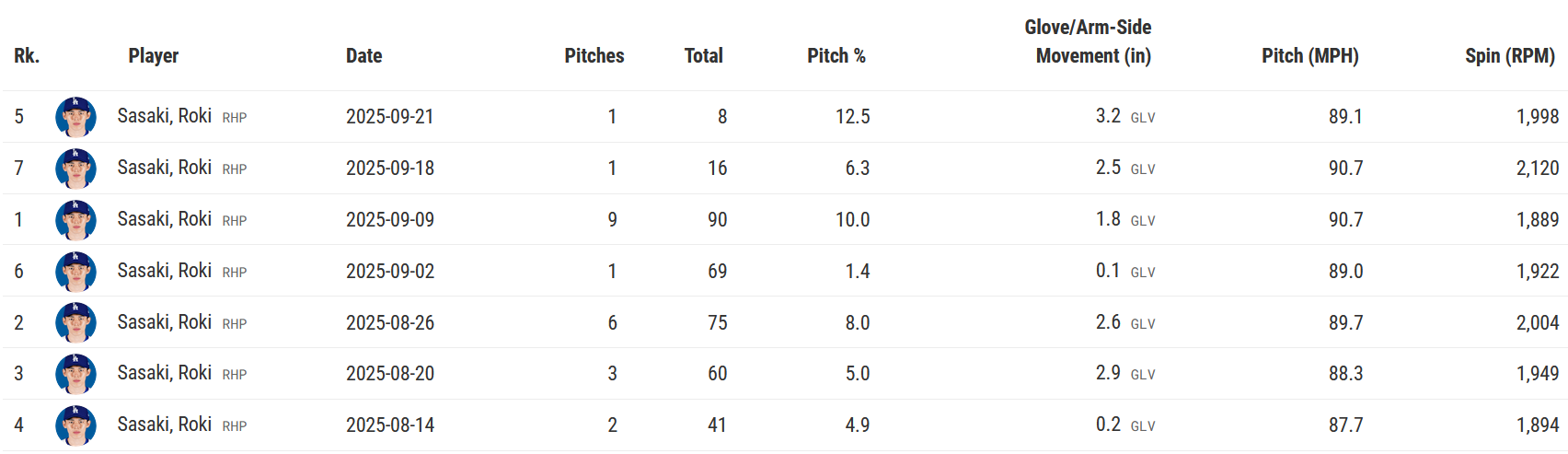
As one would expect, his cutter also saw a velo uptick over that timeframe, going from 87.7 to 90.7.
Hitters league-wide, as a whole, saw ~53,000 cutters last season. Of those, 6,440 were in the 87-88 MPH range and had a wOBA of .359 against them, while the wOBA dropped to .335 on 8,197 cutters that were in the 90-91 range, so the velo gain was a step in the right direction for Sasaki.
——
Speaking of stepping in the right direction, that is exactly what a few of his cutters did, moving as much as 5 inches to his arm-side at times. He lost the pitches, basically, and that’ll happen now and then. That said, with such a small sample, and with the focus here being what the pitch could potentially look like metrically, I am deploying my next bit of foolishness and am going to throw out the flops (anything with arm-side movement greater than one inch) to focus on the successfully thrown cutters (again, as a starter).
*Does Math*
Well, that now puts Roki’s cutter at an average amount of glove-side movement of 2.56 inches (which did not appear to have a wide difference based on velo), and this is where things get interesting (to me). League-wide, hitters saw 385 cutters in the 90-91 range with 2-3 inches of glove side movement, and their wOBA against those was .383, which is the opposite of progress.
But it might not be anything to get all spun out about, because speaking of spin (segues are my passion), as previously mentioned, Sasaki does not get a terrific amount.
For the last bit of foolishness (of which I am aware, anyway), the average spin rate of Sasaki’s successfully thrown cutters was 2,003 RPM, and if he had thrown enough of said cutters to qualify that would rank 170th out of 171 major league pitchers. Not great! Or is it?
Looking at the league-wide sample of cutters that were 90-91 MPH with 2-3 inches of glove-side movement and having a spin rate of ,1900-2,100 RPM, we arrive at a total of just 28 pitches. And the wOBA against those pitches? A paltry, measly, minuscule .154. That is not a typo. Whew.
Living up to that will be a tall order. Speaking of height (throw things at me if you must), the final component I’m going to look at today is vertical movement without gravity. Of the successful cutters Roki threw, there was an average amount of vert of 5 inches. Of the ~53,000 cutters thrown last year, only one had the velo and the spin and the movement, both horizontal and vertical, that resembled the profile that Roki presented at Oklahoma City. And, wouldn’t ya know it, we saw it happen against the Dodgers.
He missed his spot by a plate width, so we can’t even get a good look at the one big league example from last season that does exist, but Logan Webb finds a way to be annoying at every turn. Bleh. (Yes, I could look at more years of stuff, but whatever, I wanted a shot to call Logan Webb annoying, sue me.)
Regardless, that result contributed to the batter struggles against cutters with these metrics, which is what’s important.
There are other considerations as well — release height and extension, to name two, but having already run out of comps, and having already turned what is potentially a nothingburger into a nothingburger deluxe, I think it’s a good stopping point for a profile that ended up as narrow as Sasaki’s.
——
So after trawling through all that, we arrive at a dead end. Or a dead zone, perhaps? Because when I think of a pitch that has low-ish spin, less-than-impressive velo, and not a great amount of movement (but possibly more than it ought), what comes to mind is the Dead Zone Slider. Those are pitches that don’t move like major league hitters expect, and often leaves them a bit baffled as a result. Amir Garrett carved out an 8-year major league career throwing such a pitch a whopping 43.7% of the time, and weird shit sometimes gets major league hitters out.
I don’t know whether there is something like that going on with Sasaki’s cutter, or if it’s just small sample noise, but it would be on-brand if a guy with a splitter like nobody’s ever seen ends up also bringing something else to the table as rare as hen’s teeth. Or maybe it’s just a rough draft of a thing that, after an offseason spent polishing it up, could look mighty different and this will be quickly outdated.
——
Pitchers and catchers report in less than a week, and the first Spring Training game for the Dodgers is on Feb. 23 against the Mariners, so we’re not far off from potentially having this third pitch that “goes left” front and center before us. Unfortunately, Statcast data for complex ball isn’t always available, so we may end up only being able to use our eyes, and even then, we likely won’t really know how it fares until mid-to-late March when the hitters have gotten their timing and have begun hitting secondaries.
Until then, we wait with bated breath, because the glimpses of dominance we saw last postseason left Dodger fans with a monstrous appetite for more from Roki Sasaki.
