 Dodgers Digest Los Angeles Dodgers Baseball Blog
While the MLB world waits on the impending lockout, I’m getting ahead of things by producing this valuable piece of baseball weblogging.
This is my offseason plan for your 2026 NL West Champion Dodgers. Ugh, that doesn’t has the same ring as “World Series Champion,” but alas, here we are.
Please note that this is an exercise in rosterbatory greatness, and probably futility. Almost nothing you see below is likely to happen, it’s just where I, as a fan, am with the current state of the team (which is still good/great!). The intent is to foster discussion and pass the time over the long offseason. This, also likely, won’t be the only offseason plan post this winter. Once the new Collective Bargaining Agreement is agreed to, there might have to be modifications. But we’re a ways off from that being reality.
Without further ado, here’s the plan.
======
Arbitration
- RHP Brock Stewart (Arb 2, $1.8 million)
- RHP Jake Cousins (Arb 2, $1 million)
- OF Alex Call (Arb 2, $1.9 million)
- OF Andy Pages (Arb 1, $4.9 million)
- RHP Emmet Sheehan (Arb 1, $2.1 million)
- RHP Gavin Stone (Arb 1, $1.2 million)
Note: All arbitration estimates are via MLB Trade Rumors.
Chad recently went over them one-by-one, mostly mirroring my feelings (you’ll see Call later).
Cousins is about the only guy who would be in danger of not being tendered a deal, but the Dodgers thought enough of him to bring him in before the 2026 season, even though he was recovering from Tommy John surgery. He has an option year remaining, so there are worse ways for the Dodgers to spend a million bucks.
——
Rule 5 Draft Protections
LHP Jackson Ferris
LHP Luke Fox
IF/OF Jake Gelof
LHP Adam Serwinowski
RHP Christian Zazueta
I wrote about the Rule 5 Draft protections more in-depth last month. While I could see only a couple being kept, it would make sense for the Dodgers to keep these five. Fox is a new addition, as he was sent to the Arizona Fall League and struck out 14 batters in 11 innings. The Dodgers thought enough of him to send him to the AFL, so they must like what they have in him. Also, his Pitching+ numbers are intriguing.
Hoping for the Rule 5 to get cancelled at this point. https://t.co/JKOjTN6nYl pic.twitter.com/sHQ6v3p0Xc
— Chad Moriyama (@ChadMoriyama) October 31, 2026
Small sample size on Fox, but there is talent in his left arm.
Free Agents
RHP Brusdar Graterol – 2-year minor-league deal, with incentives
RHP Jack Flaherty – 1 year, $12 million + $10 million 2028 mutual option ($3 million buyout)
OF Austin Hays – 1 year, $4 million
LHP Alex Vesia – 2 years, $24 million + $12 million 2029 club option ($2 million buyout)
For free agents, I used The Athletic, ESPN, FanGraphs and MLB Trade Rumors (when applicable) to get to the term and dollars. For example, Vesia was projected at the following:
- The Athletic: 2 years, $23 million
- ESPN: 2 year, $25 million
- FanGraphs: 2 years, $19 million
- MLBTR: 2 years, $26 million
Add ’em up, divide by four and you get 2 years, $23.25 million. With aggressive rounding, that’s how I landed on 2/24 — $12 million average annual value. The option is for the same $12 million with the buyout getting him to the high-end prediction of 2/26.
——
A quick note: This doesn’t include anything about Shoki Oda, one of the Japan’s top teenage prospects. Chad wrote about what we know about him and a potential Dodgers’ pursuit. His acquisition could be determined by the new CBA, as there’s a non-zero chance an international draft is instituted and Oda would be subject to that (if it can be put together quickly enough). But if there’s no draft, the Dodgers are the favorites to sign him as well.
——
Graterol
I don’t normally note potential minor-league signings, but I’ll make an exception for Graterol. If anyone knows more about Graterol and his arm/shoulder health than the Dodgers, I’d be surprised. For that reason, a low-risk move to bring back an electric arm (when healthy, and “when” is doing a lot of heavy lifting here) who can give the Dodgers’ bullpen a different look. He’s still a 60-plus GB% pitcher who keeps the ball in the yard and has good Stuff+ numbers on both his sinker and slider. It’s hard to let an arm like his get away, provided the team thinks he can contribute. If he is signed a 2-year MiLB deal, it would give him time to get right again without the pressure of taking up a 40-man roster spot. If he’s healthy and back to his old self, the second year of the MiLB deal would convert to an MLB deal. If not, he either latches on with another team, moves to a different professional league or retires. Whichever way it plays out, it’s hard to see him going anywhere but back to the Dodgers.
Flaherty
Welcome home, old friend. Sure, the Dodgers only had him for a few months in 2024, but Flaherty is a Southern California guy and helped the Dodgers to their eighth World Series title. He’s been wildly inconsistent since leaving the Dodgers to go back to the Tigers, but some of his best work in recent years was in his short stint in LA. He has a 4.58 ERA, 3.92 FIP and a 17.6 K-BB% over 249 1/3 innings. The Dodgers aren’t “choosing” Flaherty over Tarik Skubal, they’re supplementing his loss and choosing someone else over him (see in the upcoming section with the trades). Effectively, his main job would be to eat some innings and act as insurance, which he can do assuming his health checks out after a worrisome 2026.
Of course, there’s good that comes with Flaherty as well. Despite a reduced whiff rate, he was still in the 75th percentile in strikeout percentage (26 K%) in 2026. He’s just two years removed from being in the 90th-plus percentile in both categories.
What has changed, along with a declining whiff rate, is he’s allowing harder contact. His average exit velocity against over the last two seasons has crept to above (below?) league-average at 89.7 and 90.3 MPH. Aside from 2021 (89.8 MPH), he has never run an exit velo against that high. Since inducing softer contact is a skill, there is hope he’d regain his old form (88.9 MPH with the Dodgers in 2024). And if he’s able to reduce his exit velo against, he’s likely increasing his whiff rate. Two birds and such.
Flaherty has seen his fastball usage increase over the last two seasons to where he was throwing it nearly 50% of the time in ‘26. That might have worked when he averaged 94 MPH, but those days are probably long gone. He averaged 92.7 MPH on his 4-seamer in ‘26 – the lowest of his career. Despite that, he still allowed just a .218 batting average against, so the ability for it to be an effective pitch is still there. Oh, Stuff+ rated his fastball 106 – the same as Shohei Ohtani, for what it’s worth.
The problem might be in his breaking ball usage. He has, perhaps stubbornly, been committed to throwing his slider more than his knuckle curveball. Stuff+ is pretty adamant the knuckle curve is a superior pitch to the slider (and Flaherty’s best pitch overall), and has been for quite some time:
| Year | KC+ | SL+ |
| 2020 | 97 | 110 |
| 2021 | 97 | 104 |
| 2022 | 102 | 94 |
| 2023 | 110 | 89 |
| 2024 | 106 | 94 |
| 2025 | 113 | 92 |
| 2026 | 105 | 90 |
So, not since his first two seasons has his slider graded out better than his knuckle curve, yet he has thrown his slider 25.4% of the time from 2022-26, compared to 21.3% on his knuckle curve. And the batted ball results back up the fact he should be throwing the knuckle curve more than the slider.
| Pitch | AVG | wOBA | EV | HH% |
| Knuckle Curve | .198 | .255 | 84.0 | 30.2 |
| Slider | .262 | .336 | 89.5 | 42.0 |
Yes, you risk exposing the knuckle curve more by throwing it more, but you might also improve the slider by reducing exposure. For what it’s worth, the Dodgers had him throw the knuckle curve more (26.6%) than his slider (25.1%) when he was with LA, so the precedent exists, even by a slim margin of 1.5%.
With Flaherty, the Dodgers could also run a true 6-man starting rotation, as he could benefit from the extra day of rest. We already know the Dodgers run a modified version of it and off days help make that easier, but guys like Roki Sasaki, Yoshinobu Yamamoto and Ohtani could benefit greatly from it. And with Tyler Glasnow and Blake Snell having checkered injury pasts, it may, ultimately, help them, too.
At 31 years old, there’s still plenty left in the tank for ol’ J-Flare, and he won’t be counted on to carry the Dodgers’ 6-man rotation.
Hays
Pop quiz: Who leads all right-handed-hitting left fielders in wRC+ against left-handed pitchers since the start of the 2024 season? Yes, it’s Hays. Sure, that’s a little specific, but he’s also fifth in MLB among all hitters (minimum 200 plate appearances). Hays, 31, has a 161 wRC+ against southpaws over the last three seasons. He finished 2026 with the Padres after the White Sox released him in August. He would help safeguard against any Josue De Paula struggles against left-handed pitching and could give Kyle Tucker a day off here and there in right field against them. He’s not much with the glove, but he has experience at all three outfield positions. He’d be an upgrade over Alex Call because he can actually hit left-handed hitters with authority. They lose some defense at the same time, but Tommy Edman is the primary backup outfielder in this scenario. Hays is being brought in for his bat.
Vesia
Vesia is an easy pitcher to root for and the Dodgers know what they have him in him. Locking him up for 2-3 years at this point is a must. Yes, Jack Dreyer is a similar pitcher, but Vesia is the best in the majors when it comes to vertical break on his fastball. That’s his jam and that’s what makes him as valuable as he is. He’s been in the Top 1 or 2% in expected batting average over the last three seasons and he posted career-bests in xSLG (.279), wOBA (.233), xWOBA (.254) in 2026. He’s the most vital, fungible reliever the Dodgers have had over the last handful of years. And it does feel like it’s either Evan Phillips or Vesia, not both. Vesia wins out in this scenario, while Phillips lands a nice multi-year deal to be a high-leverage arm in someone else bullpen.
——
Trades
To CIN: IF Alex Freeland, OF Eduardo Quintero, RHP Marlon Nieves, OF Mike Sirota, LHP Justin Wrobleski, RHP Christian Zazueta
To LA: SS Elly De La Cruz, 3B/OF Noelvi Marte
This is the type of big swing the Dodgers need to take in terms of getting younger, more athletic and maximizing the remainder of this core’s championship window. De La Cruz is a budding superstar and, let’s be honest, doesn’t have a long-term future in Cincinnati. That doesn’t mean the Reds have to trade him, but short of an MVP-caliber 2027 campaign, his trade value will never be higher for a middling team like Cincy.
De La Cruz, 25 next season, has three more years of team control, but the idea of acquiring him should also come with the idea of a long-term contract. That’s why I don’t have the Dodgers re-signing Tarik Skubal – they can really only have so many mega contracts, even with the unknown status of the next CBA. De La Cruz is coming off his best season as a pro, as he hit .283/.365/.515 with a 139 wRC+ and 6.4 WAR. He’s not the guy who stole 67 bases two years ago, but he is the guy who crested 30 home runs for the first time and will probably best that multiple times over the next 5-7 years.
While he runs a similar strikeout rate to Teoscar Hernandez, he also walks more (career-best 11.3 BB% in 2026), is more athletic and has more power to come. Also, just take a look at his Statcast percentile rankings:
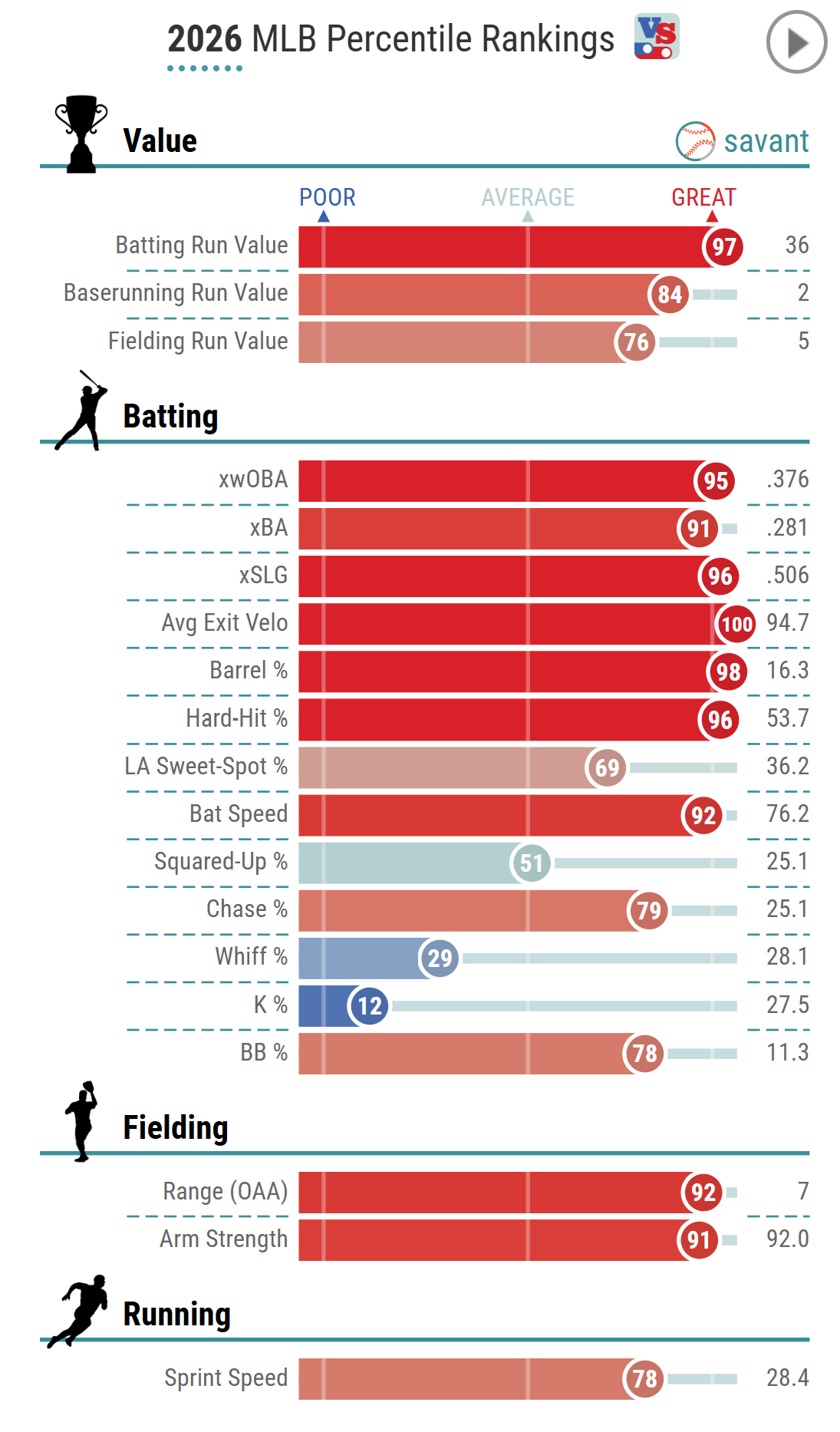
All of these (except bat speed) are career-bests and should sustain as he enters his traditional prime.
One knock against De La Cruz coming has been his inability, as a switch-hitter, to hit left-handed pitching effectively. About that…
| Year | wRC+ vs. LHP |
| 2023 | 29 |
| 2024 | 86 |
| 2025 | 67 |
| 2026 | 166 |
…and that’s without sacrificing much of anything from the left side.
| Year | wRC+ vs. RHP |
| 2023 | 107 |
| 2024 | 138 |
| 2025 | 131 |
| 2026 | 128 |
But how can a 6-foot-6 guy like De La Cruz stick at shortstop? Because he’s really good and has one of the best arms at the position. He’s +19 outs above average for his career at shortstop — 9th-best in MLB since he debuted in 2023. For context, Mookie Betts is +3 OAA in his time with the Dodgers at shortstop, though, he was +9 this season, 9th-best among MLB shortstops in 2026. If defensive runs saved is more your jam (and it is for MLB teams when it comes to infielders), it tells a different story. De La Cruz was -8 DRS last season, compared to Betts’ +7. For his career, he’s -20 DRS, sandwiched between Willy Adames (-15) and Trea Turner (-39). Betts is +27. OAA accounts more for range and the ability to make tougher plays, while DRS focuses more on the routine plays (maybe they can get Miguel Rojas on this as well). If you’re into FanGraphs’ Def statistic, De La Cruz’s 8.7 is not far off from Betts’ 10.5 in 2026. Both are well above-average.
Despite the DRS deficiency, the Dodgers made Corey Seager work at shortstop for six years, thanks to positioning. With limits on where a defender can play in the infield, De La Cruz relies more on athleticism to make up for it. That’s where the Dodgers can make De La Cruz work at shortstop — at least for now. Maybe a move to third base might be in his future, but that would have to come with a viable shortstop replacement. Because by that time, Betts might be doing more bowling than baseball. Also, De La Cruz’s arm would be wasted at, say, second base, so as long as Betts is on board, then it should be fine.
Such a move could benefit him in the long run. Second base is a less stressful defensive position to plan than shortstop. If he’s stressed a bit less on defense, perhaps that helps his bat due to not being as worn down, physically — well, that and some more days off. It’s a bummer in a way because he worked so hard to become a strong defensive shortstop, but there aren’t many guys the Dodgers could bring in who would necessitate moving Betts to second base (Bobby Witt Jr. might be the only other shortstop in baseball who would). This is circumstantial, at best, but it might be best-case scenario for the Dodgers and the remainder of Betts’ contract.
De La Cruz put on quite a show against the Dodgers this season, as he homered against them five times in six games in 2026.
Elly De La Cruz DEMOLISHES a home run 444 feet off of Tarik Skubal! pic.twitter.com/vP65PgniFI
— Talkin' Baseball (@TalkinBaseball_) September 9, 2026
It just seems like he was born to play in a large market such as Los Angeles.
——
The Dodgers would also land Marte, who helps extend the 40-man roster. He’s 25 years old, can play multiple positions (mostly third base and right field), is athletic and can run. He checks a lot of the boxes for getting younger and more athletic, but on the fringes of the roster. With one option year remaining, he could see most of his playing time come with Oklahoma City, but we all know injuries happen and Marte would be among the first to be recalled, if/when needed.
He looked to be on the verge of breaking out after a solid 2025 that saw him hit .263/.300/.448 with a 104 wRC+ in 90 games with the Reds. He went 4-for-29 to start the 2026 and was optioned to Triple-A Louisville. He was recalled in June and struggled again for two months before being optioned in August and never made it back to the majors. Still, he showed the ability to pull the ball in the air in 2025, and the Dodgers would likely try to get him back to that in 2027. His max exit velocity of 116.7 MPH in ‘25 was in the Top 3% of MLB, so the ability to hit the ball hard exists. His ground ball rate spiked by 10 percentage points, so an emphasis on lifting the ball is something that should happen.
——
Trading for De La Cruz is complicated on the surface because how many MVP-caliber 25-year-old players get traded? Not many. Juan Soto was traded at age 23 with roughly 2.5 years of team control remaining. The return the Nationals got from the Padres was substantial: CJ Abrams, MacKenzie Gore, Robert Hassell III, Jarlin Susana, James Wood, Luke Voit. Josh Bell went to the Padres as well, but the deal was essentially Abrams, Gore, Hassell III and Wood for Soto. Here are the respective global rankings from Baseball America, Baseball Prospectus and MLB Pipeline at the time of the deal:
| Player | BA | BP | MLB |
| Abrams | 9 | 11 | 9 |
| Hassell III | 30 | 26 | 38 |
| Wood | 11 | 7 | 14 |
Plus Gore, who had been a global Top 10 prospect among the three outlets the year prior. It was a hefty price, and if the Dodgers want De La Cruz, they’re gonna have to pay said hefty price. While Soto was the superior player to De La Cruz at the time of the deals (and two years younger), the extra half-year of control and his being a shortstop kinda washes it out.
As stated earlier, the Reds don’t have to trade De La Cruz now, but with the World Series champion Brewers (still sounds weird!), the Cubs, the Cardinals and the Pirates ahead of them in the division, it’s highly unlikely they’re crawling out of the cellar in the next 2-3 years anyway, so why not regroup to be in a better position to challenge for the division?
The return for the Reds would be massive. Not only do they get three of the Dodgers’ Top 4 non-Josue De Paula prospects in Quintero and Sirota and Zazueta — all of whom are Top 20-30 MLB prospects. They’d also get an immediate shortstop replacement in Freeland, a 2026 All-Star starting pitcher in Wrobleski and a lottery ticket arm in Nieves. Worth noting as well that Dalton Rushing would’ve been an intriguing substitution for somebody here as well, but his injury makes him unlikely to move and increases the prospect cost, though maybe the Reds might prefer a more proven piece anyway.
Anyway, Quintero is probably a season-and-a-half out from being the Reds’ starting center fielder. Side note: Quintero is probably my favorite prospect in the system (even more than JDP), so if I’m the Reds, I’m definitely targeting him. He’s a premium runner and defender in center field and his offensive ability is that of a future All-Star. Sirota, first acquired from the Reds in the Gavin Lux deal, goes back to Cincinnati as a global Top 20 MLB prospect. The Dodgers unlocked his potential and he’s on the cusp of making his debut in 2027. He also has a legitimate chance to stick in center field, though, would slide to a corner if Quintero works out. Zazueta, acquired for Caleb Ferguson a few years ago, was named the Dodgers’ Minor League Pitcher of the Year after a great showing between High-A and Double-A that saw him strikeout 144 hitters and walk just 20 in 103 2/3 innings. He’s on the verge of the majors. Freeland is a former Top 100 prospect who is a good defender at shortstop and, more importantly for the Reds, under team control through the 2031 season. Wrobleski is also under team control through 2031 and would allow the Reds to potentially move Nick Lodolo for prospects and replace him with Wrobo. However, a rotation of Chase Burns, Andrew Abbott, Lodolo and Wrobleski could be interesting, if not a little left-handed-heavy. If the Reds wanted Emmet Sheehan instead of Wrobleski, that’d be fine. They’re interchangeable in this scenario and carry similar value, but Sheehan is already arbitration-eligible, which is why I think the Reds would opt for Wrobleski. Nieves is the lower-level lottery ticket usually included in deals of this magnitude. He checked in at No. 29 on Bruce’s Midseason Top 50 prospects list. He’s armed with a nasty sinker/slider combination that both have 60-grade potential. He carries reliever risk due to questionable command, but there’s a lot to dream on with the arm talent.
To SEA: OF Teoscar Hernandez, RHP Landon Knack, cash
To LA: OF Gregory Pio, IF Brock Rodden
As president of the Teoscar Hernandez Fan Club, this one hurts, but is also expected. The Dodgers need to open up a spot for De Paula and with one year left on his deal, Hernandez should be somewhat attractive to an acquiring team since there’s no such thing as a bad 1-year deal. The Mariners are set to lose Randy Arozarena in free-agency and could use a viable right-handed replacement in a very winnable division. Hernandez’s stint with the Mariners in 2023 (.258/.305/.435, 107 wRC+) might have left a bad taste in the mouth of Seattle fans, but assuming they don’t bring back Arozarena or sign Seiya Suzuki, they’re going to need to find offensive production from somewhere, and Hernandez will be had a discounted rate.
Hernandez is owed $14.5 million for 2027 and has an option for 2028 at $15 million that includes a $6.5 million buyout and has a vesting clause if Hernandez spends 75 days on the injured list or has surgery for a specific injury. He has spent nearly 45 days on the IL over the last two seasons, so if it’s 75 days over the life of the contract, he only has about 30 more days before the option becomes guaranteed. In this scenario, the Dodgers aren’t paying down any of the $14.5 million, but they will be responsible for the $6.5 million buyout and the $23.5 million in deferrals from 2030-39 – which they were already on the hook for anyway.
The Mariners would also get Knack, who is out of options but could carve out a spot in Seattle as a long-reliever/spot-starter type. It’d also take a little pressure off Kade Anderson and Ryan Sloan, the latter of whom should be up sometime in 2027. Despite the memes about him, he’s perfectly viable as starter depth.
The Dodgers would get a low-level prospect in Pio who signed with the Mariners out of the Dominican Republic as an international amateur free agent in January. Here is what MLB Pipeline has to say about him:
“A right-handed 5-foot-11 hitter with current wiry strength, Pio has a chance to have impact at the plate in the future. It’s a power-over-hit profile that might always include some swing-and-miss to go along with a ton of raw power to tap into. He’s an aggressive hitter who already shows the ability to find pitches on the inner half and lift them to his pull side. While he displays impressive bat speed, there is some length to his swing because of a bat wrap in his setup, and he has work to do in terms of recognizing spin and overall plate coverage.”
Sounds like a Dodger prospect to me.
They’d also land a super utility player in Rodden, 26, who helps fill out the 40-man roster and provides some insurance against an Edman or Hyeseong Kim injury. He’s 5-foot-7 and fits the Edman role almost to a T. Of course, he has a long way to go to get anywhere near Edman, but he has shown some pop, defensive versatility and the ability to swipe a base.
To MIN: RHP Gavin Stone, OF/1B James Tibbs III, IF Joendry Vargas
To LA: IF Royce Lewis, C Eduardo Tait, OF/1B Gabriel Gonzalez
This might be the riskiest trade in this post. The Dodgers would be banking on Lewis regaining his 2023 former rather than the guy he has been ever since (which is a near replacement-level option). The No. 1 overall pick in 2017, has dealt with a multitude of injuries in his career, and varying levels of success.
In 58 games in 2023, Lewis hit .309/.372/.548 with an eye-popping 152 wRC+. He looked to be well on his way to superstardom. He regressed significantly in 2024 (107 wRC+) before posting back-to-back 85 wRC+ seasons that also included a demotion to the minors this past season. But why would the Dodgers want him?
Well, he’s younger (27), has recent experience at all the non-shortstop infield positions and still swings the bat with authority. His 75.1 MPH bat speed landed him in the 86th percentile among MLB hitters. It would have bested Ohtani’s 74.7 MPH this season, but that’s in part due to the nagging injuries Ohtani dealt with for the latter-half of the campaign. And while bat speed doesn’t tell the entire story, it’s nice to have some variety among the hitters in the lineup. There are positive correlations when it comes to bat speed and higher wOBA, but it also comes with more swing-and-miss, which makes sense for non-elite players. At the same time, Lewis had a 72.6 Ideal Attack Angle%, which topped the Dodgers’ best player in that department in Will Smith (65.7%). Bat speed and a high percentage of ideal attack angle on the ball? Couple all that with the fact that he still pulls the ball in the air a lot – 28.4% – and there’s a chance that Lewis can get back to the player he was a few years ago.
Of course, injuries are the biggest concern. Here are a list of injuries he has sustained since he made his MLB debut:
- 2022: Knee bone bruise (led to offseason surgery)
- 2023: Oblique strain, hamstring strain, quad strain
- 2024: Quad strain, adductor strain
- 2025: Hamstring strain, knee sprain, hamstring strain
- 2026: Knee sprain
That’s … a lot. No real serious injuries, but sometimes, the smaller/nagging injuries can be more detrimental to a player long-term (not that a player ever wants to suffer a major injury). It’s partly a reason the Twins might be open to moving him because they’ve run out of ways to try to keep him healthy – that and the fact he’s projected to make $5.1 million in his second year of arbitration (and that number will only increase next year).
The idea behind getting Lewis would be to give Mookie Betts (the 2B version), Freddie Freeman, Max Muncy some additional time off during the season so that those guys can be as fresh as possible for October. It might be hard to convince all of them of that, but there’s no reason Freeman should be playing more than 140 regular-season games. The same goes for Betts (when he doesn’t miss time due to injury). And the Dodgers already treat Muncy as a quasi-platoon player at times, so not a whole lot would have to chance in that regard. Some of that playing time will also go to Edman as well.
Not only do the Dodgers land Lewis, but they replenish their catching depth on the farm with Tait. He was acquired from the Phillies at the 2025 trade deadline as part of the Jhoan Duran trade. It may feel like selling a little low/quickly on him, but the Twins used the No. 3 pick in the 2026 draft on Vahn Lackey, who could very well make his MLB debut sometime next summer (but no later than spring 2028). That’s not to say the Twins should give him away, but if they can land some immediate help for a team in a winnable division, it might make sense to move the 20-year-old who’s 2-3 years from the majors. FanGraphs called him a left-handed Jorge Alfaro. Alfaro was once a top catching prospect, so let’s consider that praise. He’s a power over hit guy who’s an average defender with a double-plus throwing arm. They’d also land a Tibbs III replacement in Gonzalez, who has two option years remaining and a chance to carve out a right-handed bench bat role with the Dodgers in the future. He’s good at controlling the strike zone and has a little bit of pop.
The price to pay here is substantial. Stone and Tibbs III slot into the 2027 Twins’ plans and give them cheap, talented options for the next handful of years. With David Festa undergoing thoracic outlet syndrome surgery, Pablo Lopez coming back from Tommy John and the chance Joe Ryan can get traded at any time (especially since the Twins declined their side of a mutual option, costing Ryan almost $3.5 million in salary), adding a potentially better version of Festa in Stone makes a lot of sense. He’s coming back from shoulder surgery and in 15 1/3 Triple-A innings last season, his velocity was about in line with what it was pre-injury, which is encouraging for his long-term outlook. Tibbs III jumps in and takes the Josh Bell plate appearances, as he exercised his option to become a free agent. If they were to bring Bell back, then the Twins would still have a solid bench bat/future starter in the minors ready to come up when Byron Buxton and Emmanuel Rodriguez inevitably end up on the injured list. He’s an upgrade over Gonzalez, so it’s a bit of reshuffling the chairs for both teams. They’d also nab a former top international prospect in Vargas, which would mark the second time the Dodgers have traded a Vargas to an American League Central ballclub.
To ATL: OF Alex Call
To LA: LHP Landon Beidelschies
This iteration of the Dodgers don’t have room for a light-hitting righty outfielder in Call. Hell, they didn’t have room for him on either the NLDS or NLCS rosters. The Braves have a need for outfield depth, and Call could carve out a solid platoon situation with Mike Yastrzmeski in left field and give Ronald Acuna Jr. some days off in right field. With three years of team control remaining, Call would be a solid get for Atlanta.
Coming the Dodgers’ way is a command-over-stuff lefty in Beidelschies, who is a couple years away from needing to be added to the 40-man roster – value in its own right for the Dodgers, who are seemingly always facing a 40-man roster crunch. The 2025 6th-rounder has a 4-pitch mix, with his slider grading out as his best offering. His fastball is an unspectacular low-90s pitch, while has a potentially average curveball and changeup. If he makes it to the majors, he’ll either be a back-end starter/swingman or could shift to a full-time bullpen role and be tough on left-handed hitters. He was college teammates with Dodger prospect Zach Root.
——
26-Man Roster
Catchers (2)
Hunter Feduccia
Will Smith
Infielders (5)
Mookie Betts
Elly De La Cruz
Freddie Freeman
Royce Lewis
Max Muncy
Outfielders (4)
Josue De Paula
Austin Hays
Andy Pages
Kyle Tucker
Infielders/Outfielders (1)
Tommy Edman
Two-way player (1)
Shohei Ohtani
Rotation (6)
Jack Flaherty
Tyler Glasnow
Roki Sasaki
Emmet Sheehan
Blake Snell
Yoshinobu Yamamoto
Bullpen (7)
Edwin Diaz
Jack Dreyer
Edgardo Henriquez
Kyle Hurt
Tanner Scott
Brock Stewart
Alex Vesia
40-Man Roster (14)
Eliezer Alfonzo
Ben Casparius
Jake Cousins
Jackson Ferris
Luke Fox
Jake Gelof
Paul Gervase
Gabriel Gonzalez
Seth Halvorsen
Hyeseong Kim
Noelvi Marte
Bobby Miller
Brock Rodden
Adam Serwinowski
Injured (2)
Will Klein
Dalton Rushing
Restricted List (1)
Andrew Toles
======
The odds of most of this happening are minuscule. But the point of this post is to have a little fun, and acquiring a guy like De La Cruz is fun! There’s a lot of shuffling going on with these transactions above. It’s probably too much to be realistic, but the Dodgers should and will focus on getting younger in the couple spots they can this offseason, with more of that to come in future offseasons once the dinosaurs reach the end of their contracts.
We’ll see what happens with the CBA, so expect an updated/new version of this sometime in the spring, provided there aren’t a lot of moves before Dec. 1 at 8:59 p.m. Pacific time.
Let me know what you think in the comments and/or on Twitter, BlueSky or Discord.
