 Dodgers Digest Los Angeles Dodgers Baseball Blog
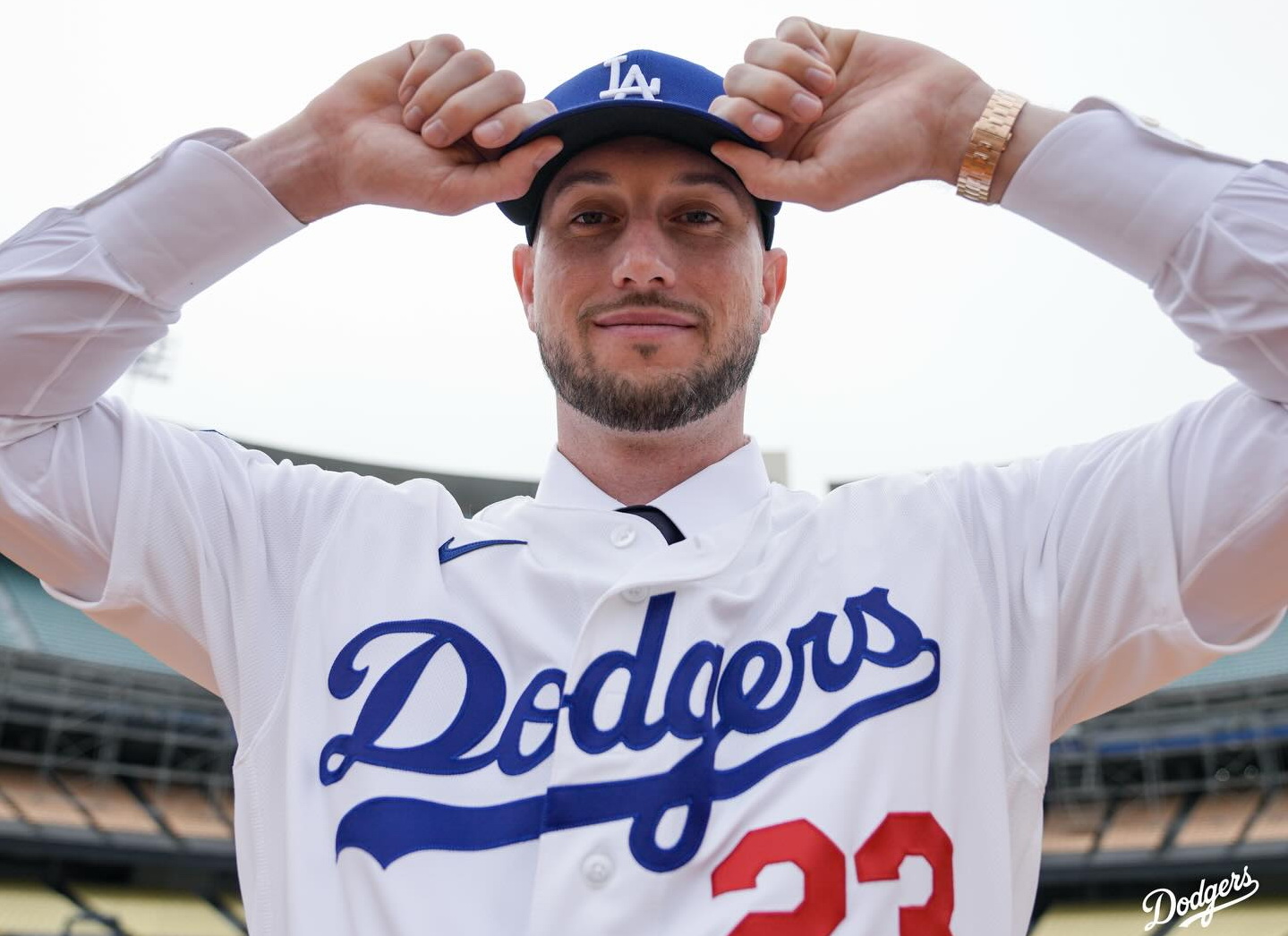
Hello and welcome back. As you can imagine, there’s more Kyle Tucker content because … well, it’s a huge story with a huge impact, as you’ll see soon. There’s also more optimism within 2026 projections for both the major-league team and the minor-league prospects. Feels good.
======
While there were a bunch of reactions to the Kyle Tucker signing in the previous Dodgers Roundup, the passage of time has led to more detailed analysis.
MLB: Some guy named Mike Petriello wrote about how a move to Dodger Stadium and recovery from a fractured hand should help Tucker immensely.
It is, probably, a combination of all of it, of the hand, the Wrigley wind, and again that his second half was mostly about six weeks long. But either way, this much is clear: For all of 2024 and the first half of 2025, he was the fifth-best hitter in the game, behind only Judge, Ohtani, Soto, and Yordan Alvarez.
If it really does turn out that playing through the hand injury is what caused his second half to slide, then it might not matter where calls home. After all: Tucker has been an elite star for more than a few years now.
Down On The Farm: How much of an impact should he make? The projections here for Tucker mostly see him being a huge upgrade against righties, though a lot of that is because Alex Call is pretty underrated as a platoon guy against lefties. Either way, they come up with a 23-run improvement per 150 games via basic wRC projections, and a whopping 42 per 150 via their simulator that takes into account the specific team context.
Essentially, Tucker improves the run-scoring conga line with his power and on-base combo, making him, those who hit before him, and those after him far more productive. Tucker will now hit behind a triad of elite bats in Shohei Ohtani, Freddie Freeman, and Mookie Betts, the latter who looks to rebound from a slow (for his standards), sickness-stunted 2025. Each of these players is an all-around stud, and they’re especially strong at getting on base, giving Tucker more chances to drive them in. Looking behind Tucker in the lineup only reveals more talent that makes pitching around Tucker ill-advised—Will Smith, Teoscar Hernández, and Max Muncy are each high-level bats. Tucker’s strong OBP will enable these power bats to generate even more runs than they did in 2025. Tucker’s impact is further magnified by the fact that the hitters he’s replacing—Kim, Call, and Rushing—all project as average-to-below-average hitters.
There’s definitely an underrated takeaway here about being cognizant about production within a team context, because as the team collectively improves there’s going to be a cumulative effect that’s generated on the totality of the roster. I think we intuitively know this — a great hitter setting the table for three scrubs is going to have less impact than a great hitter setting the table for three All-Stars — but it’s nice to have it put into more objective framing.
Big West Dugout: Thought this was an interesting look at the Tucker deal (and Gavin Lux being traded twice) from an economics perspective.
The paradox of plenty in MLB is not about disliking money, draft picks, or ambition. It’s about understanding what actually produces sustained success.
Resources matter. But they are inert without institutions. And institutions only strengthen when mistakes are costly enough to demand correction.
Constraint is not the enemy of winning. In baseball, it is often the cause of it.
As surplus continues to flow – from draft to market, from control to capital – the real question facing fans and front offices is not who is accumulating the most resources.
It’s this:
Which teams are building institutions, and which are just replenishing inputs?
That distinction determines who escapes the curse.
It seems to distinguish between teams who either don’t try their best to win or who do try but don’t have a coherent vision, and teams who are all pulling in one direction from top to bottom, as the Dodgers like to say.
——
MLB: Aside from the addition of Tucker, Manny Randhawa writes about how the Dodgers seemed poised to be better in 2026 anyway. Mostly his argument revolves around four factors: Shohei Ohtani having a full season as a pitcher, Mookie Betts returning to form, Roki Sasaki being better prepared for his sophomore campaign, and the bullpen not being as catastrophically bad as they were last year due to the addition of Edwin Diaz and Tanner Scott presumably improving.
FanGraphs: Speaking of being better, here’s a look at the ZiPS projection for the Dodgers roster, though it is before Tucker signed. It’s rather conservative by nature … and it’s still quite remarkable.
——
Apparently it was Top 100 week and I was unaware, but a ton of prospect info just dropped.
MLB Pipeline: Their Top 100 includes five Dodgers prospects: Josue De Paula at #15, Zyhir Hope at #27, Eduardo Quintero at #30, Mike Sirota at #60, and Emil Morales at #92. No real huge surprises here.
MLB Pipeline: River Ryan was named as their best prospect outside of the Top 100.
MLB Pipeline: Jackson Ferris was among those who just missed out on their Top 100.
Baseball America: This Top 100 saw four Dodgers prospects landing on the list: Quintero at #20, De Paula at #24, Sirota at #45, and Hope at #63. All outfielders.
Baseball America: Other Dodgers prospects receiving votes for their Top 100 were Alex Freeland, Ferris, Morales, Charles Davalan, and Ryan.
The Athletic: Keith Law’s prospect thoughts are always interesting to me because he tends to differ more from industry consensus than most, and he puts seven Dodgers prospects in his Top 100: Quintero at #9, De Paula at #20, Hope at #36, Sirota at #51, Ryan at #55, Morales at #65, and Freeland at #87. Quintero and Ryan that high are outliers, but I understand both, personally.
The Athletic: Among those who just missed his Top 100 was Ching-Hsien Ko.
Ko has the tools to be on the top 100, but the consistent response I heard from scouts and execs was that they wanted him to prove the production he showed in the Arizona Complex League, where he hit .367/.487/.539, would hold up when he faces better pitching. He did finish last year in Low A, where he hit .219/.355/.281 in 32 games, getting burned in large part by an overly passive approach where he took too many strikes.
Ko is going to end up hitting for power, though, as he’s 6-foot-3 and already north of his listed 215, with quick hands and good rhythm to the swing. He’s really upright to start out at the plate, and he’s not quick out of the box, showing average speed underway. He’s probably a corner outfielder in the end, with a chance to hit for 25-plus homer power and get on base. His 2025 season was a great start, and the stint in Low A showed he’s a little further away than some of his system-mates like Emil Morales.
ESPN: Kiley McDaniel’s Top 100 had five Dodgers prospects placed: De Paula at #21, Quintero at #37, Hope at #40, Sirota at #55, and Morales at #65.
ESPN: In the next 100, there were seven more: Freeland at #103, Zach Ehrhard at #111, Ryan at #125, Ferris at #128, James Tibbs III at #131, Christian Zazueta at #156, and Adam Serwinowski at #196. That feels like a lot. Promising.
NBC Sports: Christopher Crawford is the high man on the Dodgers system with eight prospects in his Top 100: De Paula at #9, Quintero at #24, Hope at #27, Sirota at #58, Morales at #65, Freeland at #73, Ferris at #92, and Ryan at #98. De Paula that high stands out just because it’s still pre-breakout, at least for his power potential.
TJStats: Probably a more metrics-focused Top 100 sees six Dodgers prospects in: De Paula at #34, Hope at #35, Quintero at #36, Sirota at #52, Freeland at #81, and Ryan at #99.
Baseball America: Back to more individual stuff, Sirota was of particular note to them, as he was named as a prospect who could make a leap even within their Top 100.
Were it not for a knee injury, Sirota might already be much higher on this list. The Northeastern-bred outfielder was off to a scalding start in the Midwest League before his season ended. Still, the reviews were clear: He has the toolset and the polish to jump to the head of Los Angeles’ cluster of talented outfielders. If he returns unscathed, he could jump right back on the rocket ship.
Personally kind of convinced that if it wasn’t for the injury he might be seen more like Quintero is, so this tracks.
ESPN: Ferris was also named as the Top 101-200 prospect most likely to throw 200 innings.
The qualities needed here are demonstrated health and durability along with enough stuff to be in a rotation and enough command to stay there, with the best candidates already in the upper minors. Ferris fits this well, as he has thrown 126⅔ innings in 2024 and 126 innings in 2025 and has fourth starter-type stuff with starter command. He’ll probably need to take one more step forward in stuff or command to actually hit 200 innings in the big leagues, but the ceiling is there.
MLB Pipeline: Zazueta, Serwinowski, and Zach Root are named as their potential Top 100 guys in the future.
Root lives in the zone with a solid four-pitch mix that plays up because of the deception from an unorthodox delivery that he repeats well. His changeup and curve got plenty of whiffs at Arkansas, with the former eliciting chases at a 39 percent clip, per Synergy. His slider/cutter is another fine offering, although his sinking fastball has looked hittable at times, so the Dodgers had him working on a riding four-seamer that tops out in the upper 90s.
TJStats: Zazueta is among the prospects he expects to be in the 2027 Top 100, along with Morales.
Baseball America: For potential breakout prospects in the system, they name Zazueta, Kellon Lindsey, and Brendan Tunink, the latter being of particular note since I had not seen his name mentioned much before.
Tunink is one of the most athletic players in the Dodgers’ system, but he has clear holes to fix before he can get the most out of his ability. His swing path is geared to do damage on pitches down and in but leaves him with holes elsewhere. Those vulnerable patches showed up in elevated miss rates overall (34%) and on pitches in the zone (26.8%). Tunink makes plenty of impact when he connects, as shown by a 90th percentile exit velocity of 102.6 mph. Scouts believe Tunink can hold down center field thanks to plus speed, but he’ll need to sharpen up his instincts to play even cleaner defense. He has average arm strength.
FanGraphs: On their ranking of international prospects, there was only Rubel Arias checking in at #24 from the Dodgers class of 2026.
——
Off-season content can be insightful, like Yoshinobu Yamamoto sitting down for dinner with his former teammates from the Orix Buffaloes.
The whole thing is worth a watch (it has subtitles now, I think), but of particular note to me was the fact that he admits to being unsettled in his first year and didn’t want to assert himself back then.
Yoshinobu Yamamoto talked with his former teammates.
— Chad Moriyama (@ChadMoriyama) January 22, 2026
Said he wasn't settled in his first year, ended up moving three times. He also went along with their way of pitching back then, but this year he did things his own way. https://t.co/5SmNxmQFw0
Safe to say doing things his way worked, and it’s honestly also reason for optimism with regards to Roki’s second year.
Also, Yamamoto named Mookie as a teammate that helped him.
Says he goes out with the Japanese teammates most, but outside of that, he's close with Mookie. They rehabbed together, and he told Yama to come over to his house any time and there's a ton of stuff to do, he buys Yama meals, and speaks English slowly so he can understand.
— Chad Moriyama (@ChadMoriyama) January 22, 2026
I always love to get tidbits of behind-the-scenes stuff, just because we have so much information about everything nowadays except things of that nature, and they could be just as important as anything else (or more, really).
======
Don’t know about how fans of the rest of the league feel (and don’t really care), but I’m pumped for the 2026 season.
