 Dodgers Digest Los Angeles Dodgers Baseball Blog
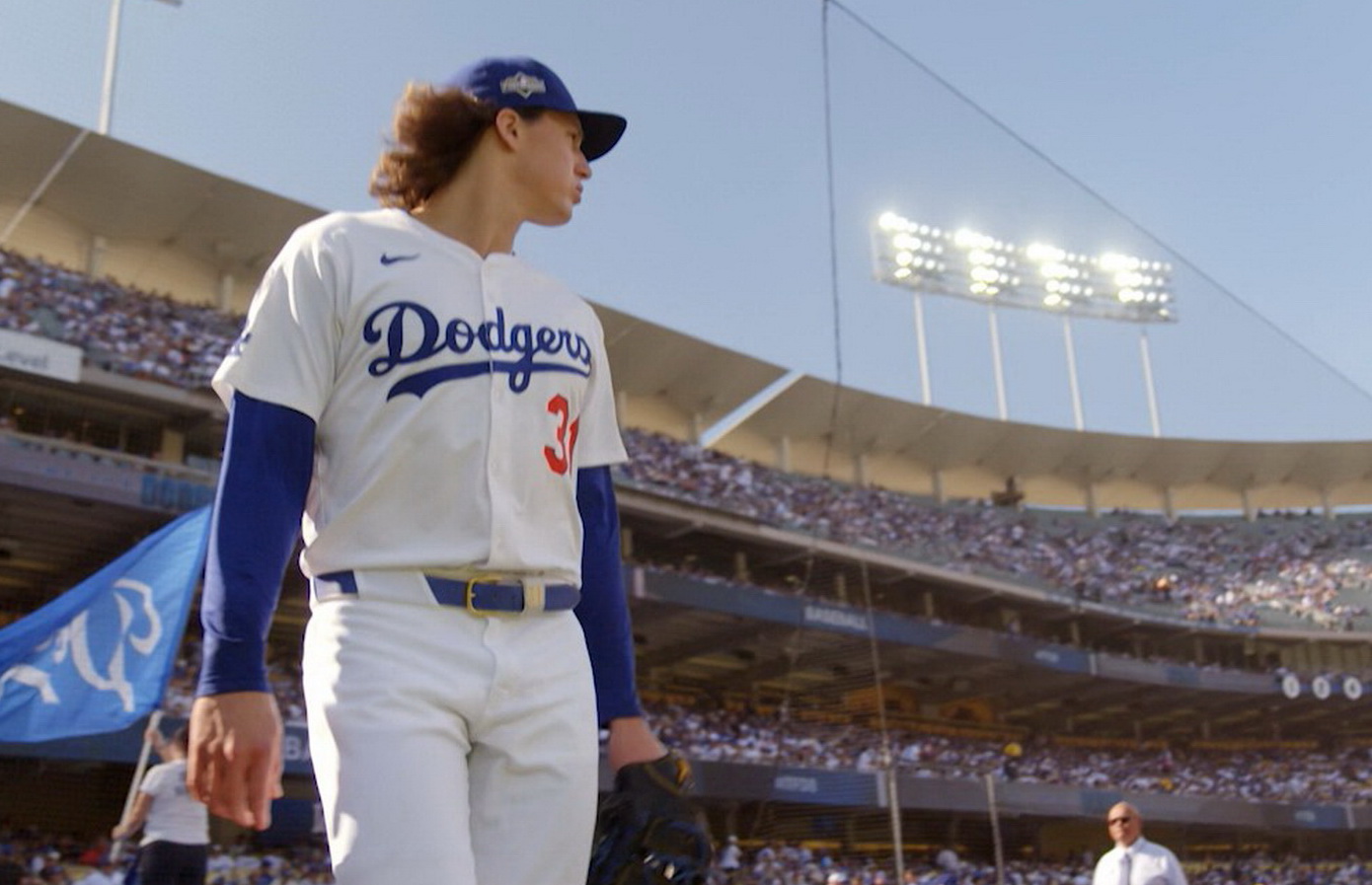
When I was doing my five bold predictions for 2026, someone had mentioned Tyler Glasnow and winning the NL Cy Young award. I thought to myself, “Huh, I could actually see that happening.“
While we’re still in April, Glasnow has never looked better at any stage of his career. He leads all Dodger starting pitchers in fWAR (1.3), K-BB% (25.8), xFIP (2.48), SIERA (2.75) and he’s averaging 6 2/3 innings per start. The talent has never been a question for Glasnow; it has always been his durability. He has still never pitched more than 134 innings in a season (2024), and it’s highly unlikely he’s going to throw 200 innings this season. The thing is, the Dodgers don’t need him or any starter on the roster to do that. Instead, maximizing the time their in the game while also doing their best to have them ready for October has always been the plan. That plan went awry in 2024, but worked perfectly in 2025.
Glasnow, 32, was a 5th-round selection by the Pirates in the famed 2011 MLB Draft out of Hart High School in Santa Clarita. He has long since been known as a guy with great stuff, durability concerns and sometimes questionable command/control. That last bit is where Glasnow has improved most so far in the 2026 season.
He ran an 11.7 BB% last season — the highest of his career. He has reduced that by half so far in 2026, while maintaining (actually slightly improving) his strikeouts from ’25 — 29 K% to 31.7 K%. He’s also keeping the ball in the park much better than he has at any point of his career. He has allowed two homers in 33 innings, which translates to a 0.55 HR/9. He is also running a career-best 6.7 HR/FB%, despite his fly ball rate being higher than 40% for the first time since 2022.
He has made a few changes to his repertoire. This season, he has added a knuckle curveball, to go along with his already plus-curveball. He has increased his sinker/2-seamer usage
| Pitch | ’24 Usage% | ’25 Usage% | ’26 Usage% |
| 4-Seam | 45.2 | 36.3 | 31.6 |
| Curveball* | 18.6 | 21.9 | 28.5 |
| Slider | 27.7 | 22.1 | 16.8 |
| Sinker | 8.5 | 19.7 | 23.2 |
*Includes knuckle curveball in 2026; not thrown before.
In what seems to be a trend across baseball, 4-seam fastball usage is trending downward for Glasnow, while his secondaries are trending up. What’s interesting to note is that he’s throwing more sinkers since he threw 33.1% sinkers in 2017 while still with the Pirates. It was a pitch he ditched, for the most part (24 thrown in 2020) until he came to the Dodgers. Since coming to LA, the usage has only increased. Despite increasing usage, it has actually gotten better in that time.
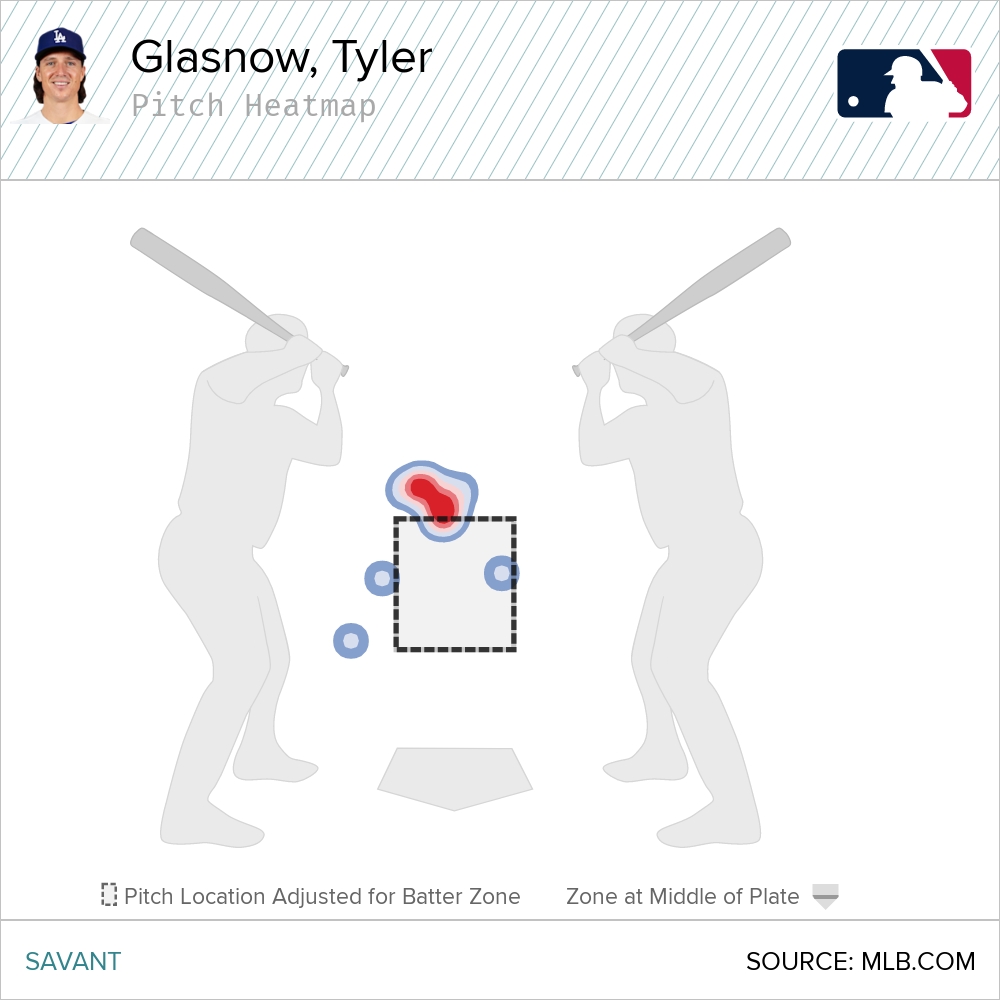
Glasnow also has a somewhat abnormal average launch angle of 18 degrees on his sinker. That has increased the last three seasons from 4 degrees in 2024 and 15 degrees last season. Here’s what it looks like on the pitch heatmap.
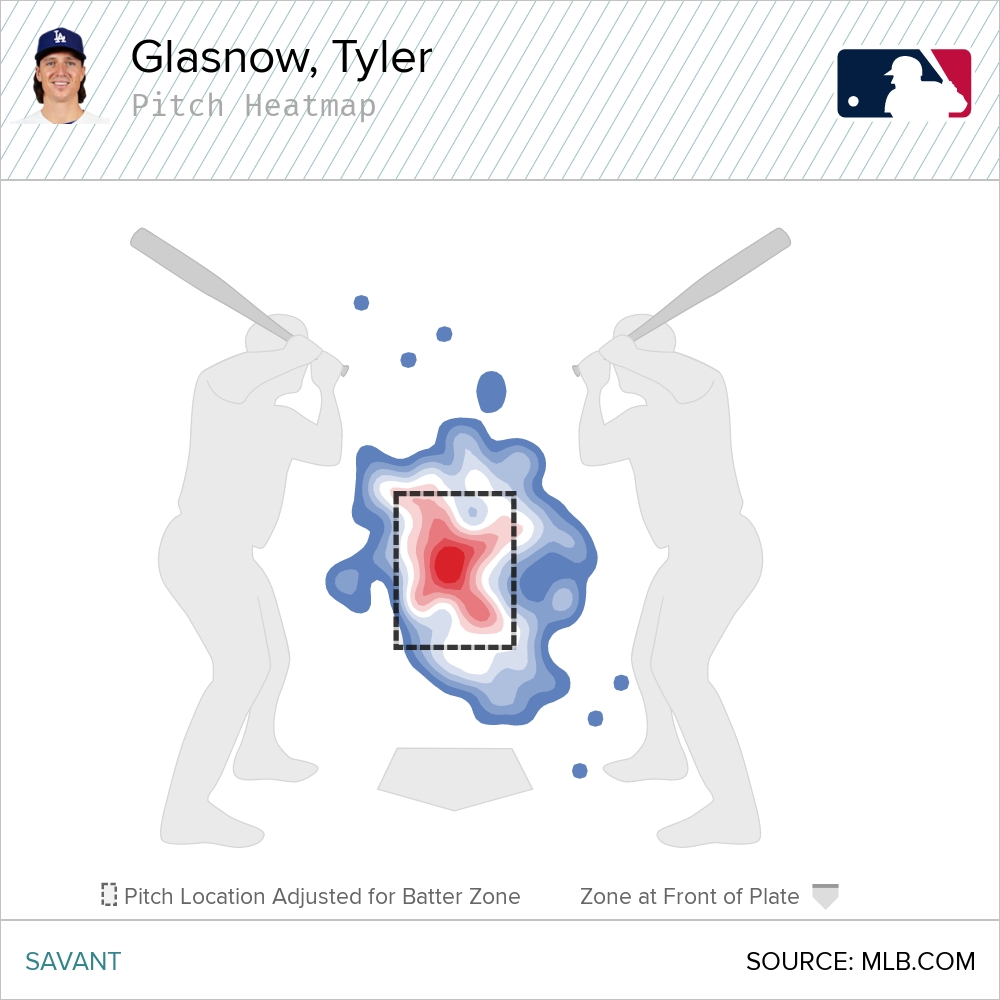
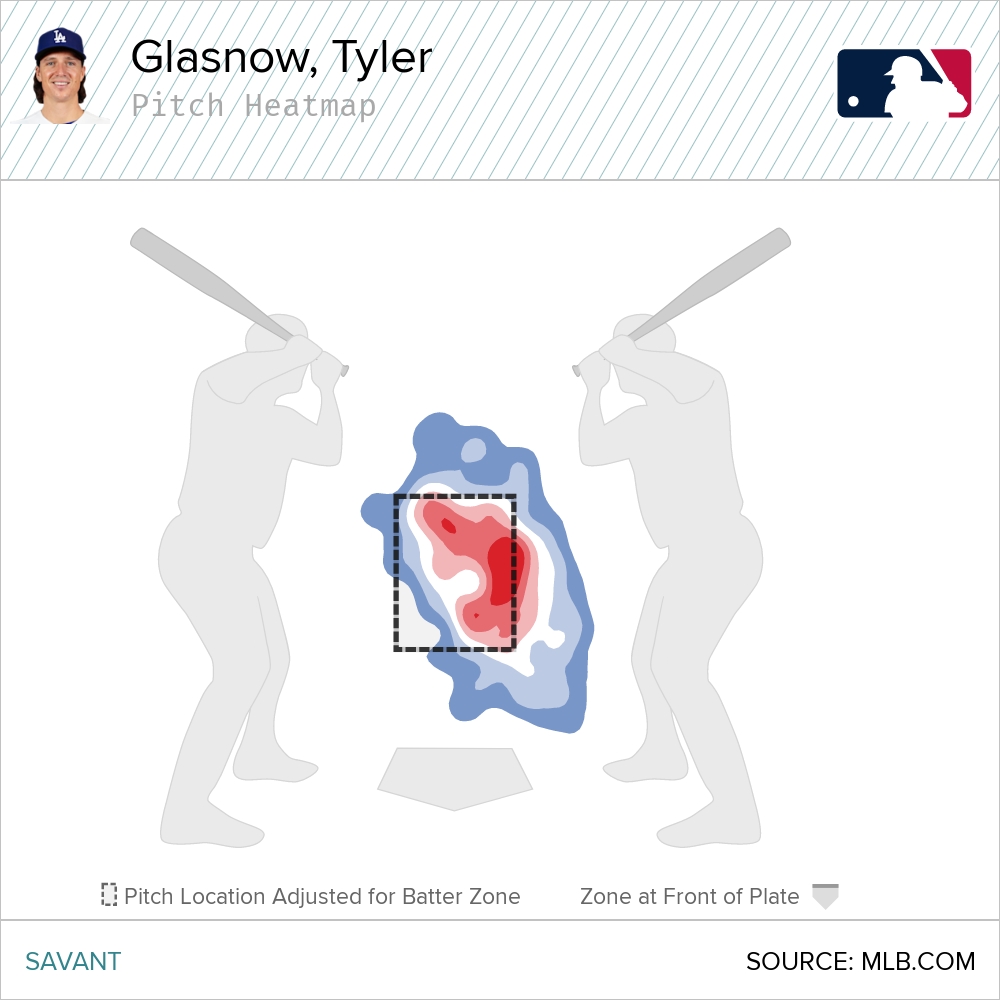
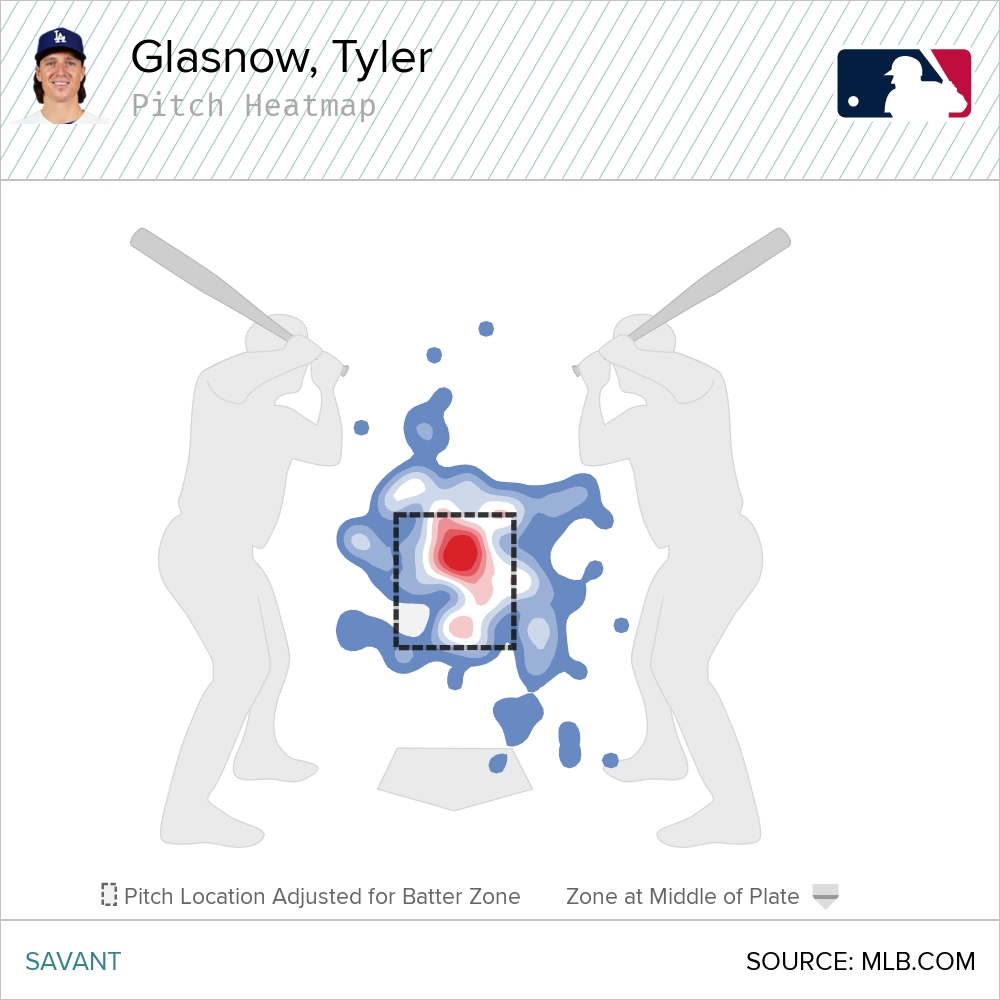
Fewer of his sinkers are below the strike zone, compared to previous years. He has a lot more sinkers that are above the strike zone, and the warmest part of the heatmap is right down the middle, but up in the strike zone. That has led to the higher-than-expected launch angle. His 23.3 Whiff% on the sinker is second-best among pitchers with more than 100 sinkers thrown (Jose Soriano, 28.6%). Sinkers aren’t, traditionally, whiff-inducing pitches, so that’s helping to make it even more effective.
A reason his sinker might work well higher in the strike zone because of the spin rate. He has a 2,482 RPM on his sinker this season — highest in MLB. Of the five starting pitchers who have spin rates of 2,400 or higher on sinkers, Glasnow’s 18-degree average launch angle is the highest — Shota Imanaga‘s 9 degrees is next-highest.
The best example of Glasnow’s sinker working as intended came in Game 6 of the 2025 World Series when he got Ernie Clement to pop out on the first pitch after he relieved Roki Sasaki. And if you look at some of the swinging strikes on his sinker this season, you’ll notice a theme.
And we look at where the pitch was to Clement to get the crucial out.
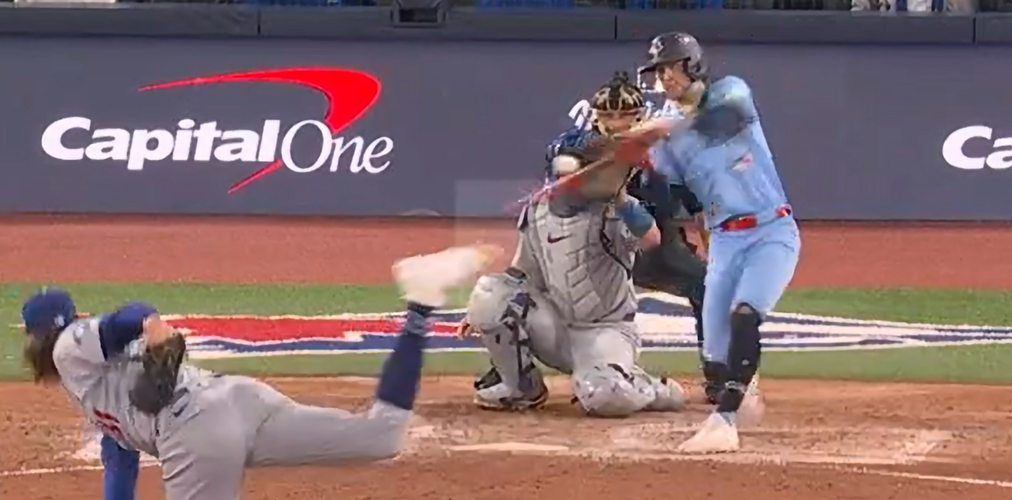
Chef’s kiss.
With an improved sinker, an already-great curveball and the addition of a knuckle curve, Glasnow has taken another step in his progression. And the knuckle curve — despite having a similar features to his 12-6 curveball, acts almost like a new pitch. It’s 3.5 MPH slower, spins a bit less and still misses bats. It’s a very small sample size, as he has never thrown a knuckle curve in his career before this point, so it’ll be something to monitor as the season progresses.
——
Glasnow is maturing and progressing as a pitcher. He’s becoming less reliant on his 4-seam fastball (which is still a plus-offering) and adapting to the situation. An abnormal sinker and the addition of a second curveball have made it to where opposing hitters have to look for different pitches in different locations with varying level so effectiveness.
He may not win the Cy Young this season. Hell, he may not even make it to 100 innings. But Glasnow is one establishing himself as one of the very best pitchers in baseball, and the rest of baseball should be aware of that.
