 Dodgers Digest Los Angeles Dodgers Baseball Blog
It’s not your imagination, the Dodgers offense has been struggling mightily for over a month now, and it’s played a big role in the team having a losing record of 13-17 since the start of July and are now losers of seven in a row. Often portrayed as an unstoppable juggernaut, the Dodgers have a 95 wRC+ over that span (heading into games on August 7th), below league-average and ranking 20th in baseball as they’ve had to resort to grinding out wins.
It wasn’t always like that, of course. The Dodgers led the league in wRC+ in March/April, were second in May, and were fifth in June, so there was some drop off or regression over time, but nothing alarming. After all up until June they had by far the best offense in baseball with a wRC+ of 118 outpacing the second-place Yankees at 109. Unsurprisingly, they also had the best record in baseball by 2.5 games. Needless to say, that made the falloff since rather stark.
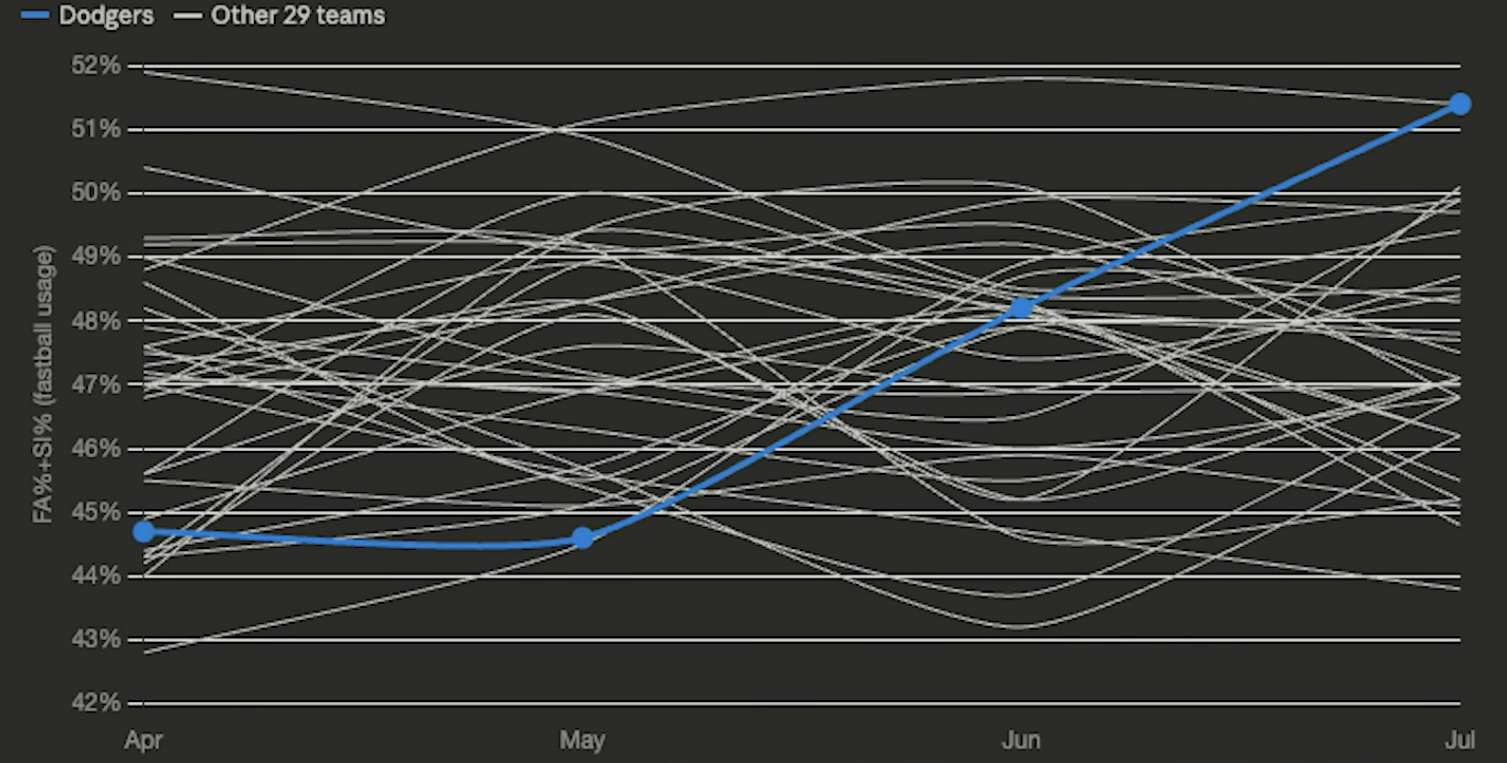
Still, there’s often ebbs and flows to the season, so it’d be easy enough to just chalk it up to that. However, this is a rare case where it seems there’s a definitive reason and plan of attack from opposing teams. As brought to my attention by Rates & Barrels, the Dodgers are being attacked (and destroyed) by fastballs.
Yeesh.
I’m usually skeptical about reading too much into percentage points of pitch changes since it can be a miniscule game-to-game difference, but that is a quite blatant shift. It also made me want to take a deeper look myself to see if the results validated the choice, so let’s do that.
——
In order to get a better grasp of what was going on, I looked at the month-by-month progression of both the usage rate of fastballs and sinkers against the Dodgers and how the Dodgers performed against both those pitches. It was revealing.
| Fastball/Sinker | Pitch% | Rank | wRC+ | Rank |
| March/April | 44.7 | 24th | 149 | 6th |
| May | 44.6 | 29th | 147 | 3rd |
| June | 48.2 | 12th | 136 | 10th |
| July/August | 51.8 | 1st | 98 | 29th |
Separating the above even simpler into two buckets, prior to July the Dodgers saw the 25th most fastballs in baseball (45.8%) and did the most damage against them in baseball to the tune of a 144 wRC+, while after they’ve seen the most fastballs in baseball and did the second-least damage. Against every other pitch type combined over the same span, their production has held steady, so the aforementioned offensive decline is essentially all about the hard stuff.
The slide did pretty obviously start in June, when teams seemingly started increasingly testing them with velocity and it became more effective. Then as the trend firmed up, the league kicked things into overdrive for July. It’s a bit of a chicken-or-egg thing in terms of cause, but it seemed like they were just falling back on the mantra of making the Dodgers prove they can hit the fastball … and they simply haven’t.
Aside from the obvious declining wRC+, their HR/FB% was 16.4 prior to July (2nd) but that has dropped to 11.0% (21st), and the lack of threat and/or damage has had a cascading effect on the offense. Fastballs are generally easier to zone for the pitcher, and thus their 10.5% walk rate (4th) has plummeted all the way down to 7.8% (23rd), which obviously leads to fewer and less explosive scoring chances.
There’s no real way around it, things are pretty bleak offensively right now. If pitchers feel confident they can beat you with the fastball, it just makes everything more comfortable and simpler for them, the last feeling a lineup wants to provide.
Shohei works the count back to full and then starts the game by lining a homer to right. pic.twitter.com/7DhPz7q5jy
— Chad Moriyama (@ChadMoriyama) August 5, 2026
Not enough of this, lately.
——
So what can they do?
Well that’s the thing, right? Probably not anything obvious like an individual pitcher adjusting a grip or something, especially since this comes on a team level.
It’s possible that some improvement could come as a result of regression and/or luck. Their BABIP against fastballs before July was .309 and .274 after, despite making similar type of contact quality (hard-hit rate and 90th percentile exit velocity), having similar batted ball distributions, and squaring the ball up more than before. One big statistical difference is they went from top 10 in contact rate and whiff rate against the fastball to bottom 10, and the same goes for whiff rate against the pitch. Perhaps related is that fastballs and sinkers were located in the shadow (edges) of the strike zone 43.6% of the time prior to July (26th), but 45.6% after (5th). That seems like something more a fluke of sample size than anything a large proportion of random pitchers can control specifically, so maybe over time more misses over the plate will also help them improve.
Of course, the easy insinuation will be that they’re struggling because they’re an older lineup, and that’s possible, but they’ve never been bat speed monsters anyway. Plus, their bat speed against fastballs is actually better since July than it was previously, and they’ve proven that they can hit them with their current swing speeds already this season. Additionally, if it is just that, then there’s basically nothing that can be done and you might as well let doomerism fully take over. But as far as being proactive, tweaking their approach as a part of the never-ending battle of adjustments against pitchers feels like the realistic solution. Perhaps being on the fastball more often can help them resume getting the bat head out in front to pull some of that quality contact again, and then everything else would fall back into equilibrium as easy as things fell out of whack. How and when to do that? Well that’s what their cadre of analytics and coaches are for, I’d hope.
======
So there’s no easy or obvious fix to this issue, though it probably couldn’t hurt to try and be more cognizant of the scouting report on the lineup as a whole that has seemingly rapidly spread across the league. Combine that with a little regression, and perhaps the addition of more regular at-bats from Tommy Edman, Enrique Hernandez, and Will Smith and/or general improvement from Kyle Tucker, Teoscar Hernandez, and Mookie Betts, and they could resume being one of the better offenses in baseball again. That’d normally feel overly optimistic about a team, but the Dodgers literally did it last year, struggling to a bottom five offense for over a month around the same time and then pulling themselves out of it to be a top five offense in September before going on to win the 2025 World Series.
Thus, I don’t think it’s quite time to hit the panic button or anything, but it’s certainly worth monitoring if the struggles continue or (god forbid) deepen over the rest of the season without any improvement, as handling the hard stuff seems to be one of the few potential roadblocks they have in their attempt to three-peat.
