 Dodgers Digest Los Angeles Dodgers Baseball Blog
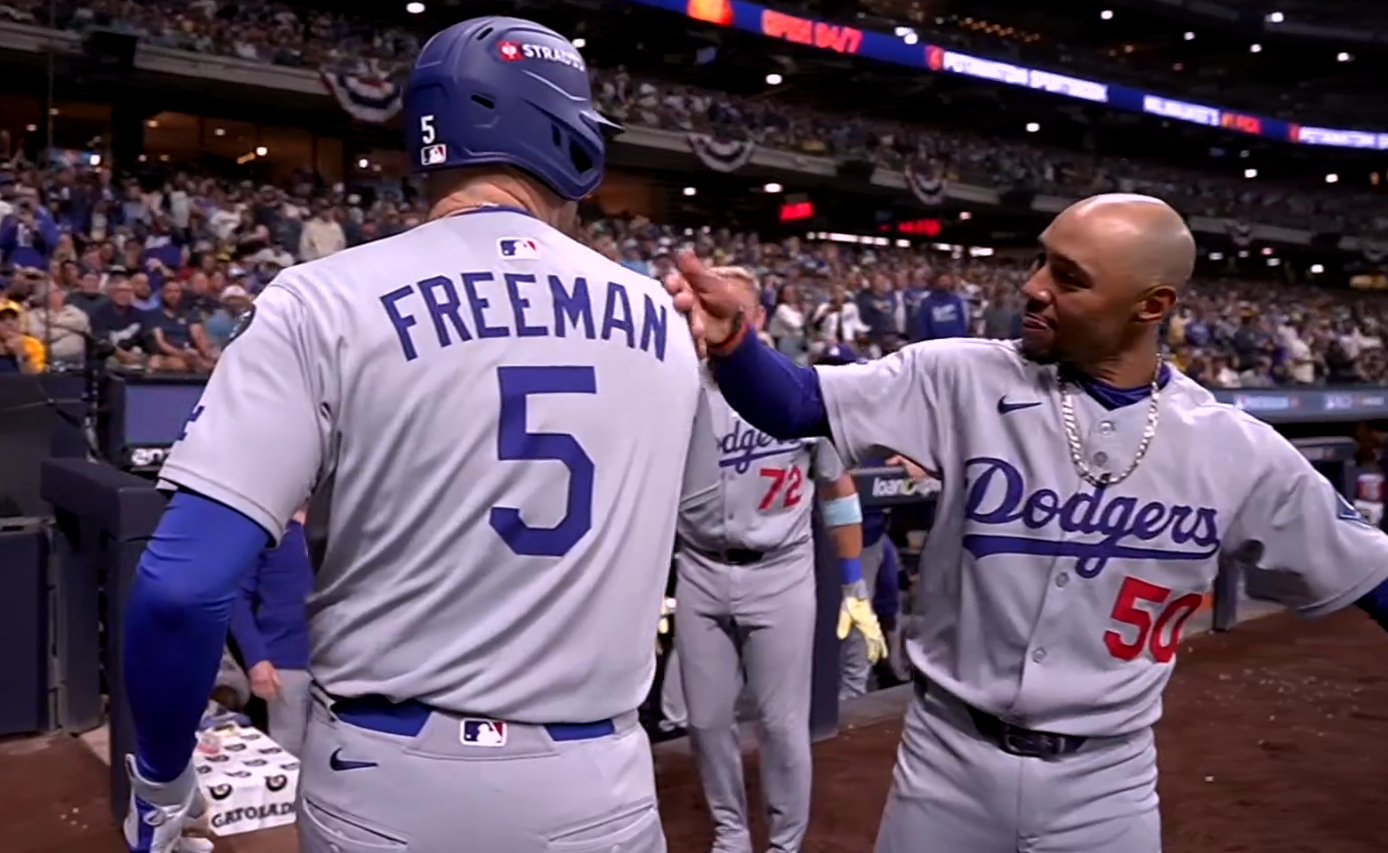
The Dodgers handled business in the NLDS, taking down Atlanta in four tight games to clinch a third consecutive trip to the NLCS. They finished the series off in Atlanta on Wednesday and only had to wait a few hours to learn their NLCS opponent. Milwaukee went down to San Diego and gentlemen swept the Padres, winning the first two games in nailbiting fashion in Milwaukee before dropping Game 3 in San Diego. They held on to a 3-1 win in Game 4 to clinch a rematch of last season’s NLCS. Last season, Milwaukee was the top seed in the NL and the Dodgers went into Milwaukee and swept the Brewers in dominant fashion, holding them to exactly one run in each of the four games. The Brewers posted a .118/.191/.193 slash line in the four games, giving them an OPS slightly below Clayton Kershaw‘s career OPS (.384 for the Brewers, .390 for Kershaw). This Brewers team should be much better-equipped to make this a tight series.
Milwaukee finished with the best record in baseball this season at 103-59 and had the best run differential at +214. They won the NL Central by 14 games and finished with the second-most runs scored (832) and the third-fewest runs allowed (618). Milwaukee took four of seven against the Dodgers this season despite getting outscored 27-25 in the seven games. The Dodgers took two of three in Milwaukee in May, losing the first game 5-1 before winning the next two 11-3 and 5-1, respectively. Milwaukee came to LA in August in the midst of one of the Dodgers’ worst stretch of the season and took three of four. Edwin Diaz blew the save in Game 1, giving up two runs on four singles before being pulled for Alex Vesia, who gave up a third run for a 5-4 Brewer win. The Dodgers took Game 2 3-1, but dropped the final two 4-1 and 6-2.
======
Dodger Lineup
I already broke down the Dodger regular season numbers in the NLDS Preview, so this will mostly focus on what the team is up to right now. The Dodger lineup as a whole struggled a bit against Atlanta with a .203/.264/.391 slash line and a .655 OPS. As we all predicted, Kyle Tucker led the Dodgers with five hits in the series. Andy Pages had a tough start to the series going 0-for-7 with three strikeouts and a walk in the first two games, but had two hits in each of the two games in Atlanta and had the game-winning two-run single in the seventh inning on Wednesday. Freddie Freeman went 4-for-15 with two walks in the series but two of his hits left the yard after he did so only once in the final 66 games of the season. Max Muncy went 3-for-12 in the series, but all three of his hits were home runs. Enrique Hernandez only had one hit in the series but it was a big one, as his two-run homer off Chris Sale was all the Dodgers needed in Game 3.
On the negative side, the Dodgers were far too reliant on homers in the NLDS. Of their 14 runs in the series, only three of them did not come on a homer. They went 1-for-16 in the series with runners in scoring position, with the one hit coming from Pages on Wednesday. Before that point, the entire Dodger offense was homers and a pair of Atlanta errors. Mookie Betts led off all four games and had three hits (all singles) and three walks. Teoscar Hernandez had a big homer in Game 1, but only had two singles the rest of the series and struck out six times. Will Smith had an abysmal series at the plate, going 1-for-16 with seven strikeouts and no walks. Tommy Edman was almost equally as bad, going 1-for-7 with a walk and a strikeout. The biggest concern was Shohei Ohtani, who came into the series as a big question mark after injuries and plate discipline contributed to a rough second half and an IL stint. He didn’t to much to alleviate the concerns, going 2-for-13 with four strikeouts and two walks in the four games and being moved down in the lineup (he hit fifth in Game 3 and cleanup in Game 4). Ohtani did show some signs (as Chad broke down in his positive takeaways piece), but they’ll likely need more out of him moving forward.
The Dodgers came out of the NLDS about as healthy as possible with one exception. Miguel Rojas left Game 3 after tweaking his back on a swing and was reportedly unavailable in Game 4. There hasn’t been an update on his availability for the NLCS, but the Dodgers decided not to replace him on the roster as it would have kept him out of the next series. Rojas doubled in his first AB of the NLDS in Game 2 against lefty Ray Kerr before going 0-for-3 with a strikeout off Sale.
——
Dodger Rotation
The Dodger pitching staff was sort of uneven in the NLDS despite only allowing eight runs in the four games. Tarik Skubal got the Game 1 start and was excellent, giving up a run on two hits in six innings with seven strikeouts. The Dodgers held Yoshinobu Yamamoto off until Game 3 in Atlanta and he was even better, giving up a run on four hits in seven innings with a postseason-career-high 10 strikeouts. Those two figure to be the starters in Games 1 and 2 in Milwaukee, though nothing has been confirmed yet. Skubal would be on six days’ rest between the two Game 1 starts and Yamamoto would be on normal rest for Game 2, but him going in Game 2 on Monday would allow him to pitch again on regular rest in Game 6 on Sunday, if needed.
On the other hand, Blake Snell and Tyler Glasnow had similar struggles in their starts. Snell started Game 2 in what seemed like an advantage for the Dodgers, with Snell going against a third-consecutive Atlanta bullpen game. Snell only recorded 11 outs, needing 90 pitches to get through 3 2/3 with five walks and five strikeouts. Snell was effective in limiting Atlanta’s scoring, giving up only three hits and one run. He threw nearly as many balls (43) as strikes (47) and put the Dodgers in a situation where they had to use more pitchers in that game (7) than Atlanta’s planned bullpen game did (6). Glasnow got the Game 4 start was a bit better than Snell, giving up only one hit and one run in 4 2/3 innings but also issuing five walks in the game. He got pulled after a pair of fifth-inning walks and needed Alex Vesia to get him out of a jam, and Vesia got Matt Olson to line out to end the threat. The lone Atlanta run of the game came on a Glasnow wild pitch, but it’s hard to blame him too much for it as it took an insane read by Michael Harris II to score on a pitch that bounced just in front of the plate. In total, Dodger starters had a 1.69 ERA in the four games and had a 31 percent strikeout rate, but also had a 14.9 percent walk rate.
——
Dodger Bullpen
The Dodger bullpen was also strong against Atlanta, posting a 2.45 ERA in 14 2/3 innings. The Dodgers used eight relievers in the NLDS and five of them posted zeros. Vesia, Brock Stewart and Evan Phillips each pitched in two of the four games and didn’t allow a run. Sasaki only pitched in Game 2 and took down the final two innings, keeping the Dodgers in the game but they were unable to score the tying run. The big surprise was Diaz, who pitched three times and looked dominant as he did down the stretch of the regular season. Diaz pitched in the sixth inning of Game 2 and threw a 1-2-3 with two strikeouts, likely leading to him rising on the trust tree. He came in for the save in Game 3 and worked around a leadoff Harris double to lock it down, and came back out to close out the series with an 8 pitch 1-2-3 ninth in Game 4.
Kris Bubic only pitched once in the series and had some rough luck, as Teo misplayed a ball into a two-out triple and Bubic uncorked a wild pitch to give up a run. Edgardo Henriquez pitched twice and looked a little rusty (after not pitching for the final two weeks of the season) in his first outing, giving up two hits and a run in Game 2. He bounced back nicely getting five outs in Game 4, needing only 15 pitches to get through 1 2/3 despite giving up a double to Harris. Tanner Scott made Game 1 closer than it needed to be, as he came into a 5-1 game in the ninth and gave up a two-run homer to Ozzie Albies before getting pulled for Phillips to get the final out. He bounced back nicely in Games 3 and 4, giving up one walk and no hits in two innings with four strikeouts.
While the Dodger rotation will likely remain unchanged from the NLDS, they’ll probably look to add some relief help in a longer series with a stretch of three games in three days. Justin Wrobleski could be a long relief option, but struggled hard against Milwaukee this season (nine runs in 11 innings over two starts) and had a 6.13 ERA in 12 outings (seven starts) after the All-Star Break. Emmet Sheehan had the opposite season as Wrobo, struggling for most of the first half before giving up one run and six hits in 17 innings over his three September outings. Jack Dreyer was a bit of a surprising omission from the NLDS roster and could be an option. The Dodgers already have three lefties in the pen and Milwaukee isn’t nearly as bad against left-handed pitching as Atlanta, but he figures to be the logical option if the Dodgers go with another one-inning relief guy.
Chad wrote a roster preview with only a few roster spots up in the air. He has Bubic and Sheehan making it over Wrobo and Dreyer. Sheehan over Wrobo makes a lot of sense, and Bubic vs Dreyer feels like a toss-up. Dreyer could make sense as his biggest issue was with the long ball and Milwaukee doesn’t really hit homers.
The Dodgers rotation alignment seems ideal for the NLCS, while there’s some debate over the swingman and lefty reliever. The last position player is probably just whether Miggy’s old-man back responds or not, but there’s a surprisingly decent alternative. https://t.co/WyxdCTkIKG https://t.co/5J0eXl6Arm
— Chad Moriyama (@ChadMoriyama) October 9, 2026
——
Brewer Lineup
The Brewers were one of the best offenses in baseball this season, finishing second in runs scored (832), tied for third in OPS (.743) and tied with the Cubs for the best walk rate in baseball (10.6 percent). They were a bit prone to strikeouts (22 percent strikeout rate, the 14th-highest mark in baseball), and while they showed more power than recent years, they still finished tied with the Twins for the 10th-best slugging percentage in baseball. They only hit 154 homers, which was the second-fewest in baseball, but they had the fifth-most doubles and sixth-most triples in baseball.
Milwaukee had three everyday players post an OPS above .800, led by a breakout year from Jake Bauers. Bauers’ .752 OPS in 2025 was a new career high for him, but he finished with a .874 this season and a team-leading 26 homers. Jackson Chourio finished with a .837 OPS and 25 homers, and Brice Turang led the team with a 5.9 fWAR and finished with a career-high .816 OPS. Andrew Vaughn lost some playing time with first base occupied by Bauers and DH occupied mostly by Christian Yelich, but he posted a .834 OPS in 331 plate appearances. He should be a big factor even if he comes off the bench, as he also OPS’d .938 against left-handed pitching.
Most of the rest of the Brewer offense finished in the .700ish OPS range. David Hamilton was listed as their primary third baseman this season, but struggled with a .650 OPS and Joey Ortiz started three of the four games against the Padres at third. Sal Frelick was Milwaukee’s primary right fielder and despite posting a .614 OPS in the regular season, he started three of the four games against the Padres. Yelich struggled this season after a strong 2025 season, with a .692 OPS and only 12 homers in 500 plate appearances.
As a whole, not unlike Atlanta, they were better against righties than lefties.
In the NLDS, the Brewers scored 13 runs in the four games against the Padres. They scored exactly three runs three times and broke out with four runs in Game 2. As a team, they OPS’d .688 in the series and struck out 26 times with 16 walks in the four games. William Contreras was the leader on offense, going 6-for-16 with a walk and two strikeouts and hitting two of Milwaukee’s three homers in the series. Chourio only went 3-for-16 in the series, but hit a homer in Game 1 to tie the game in the fourth inning. Despite their regular season struggles, Yelich and Frelick both turned in solid NLDS’s. Yelich went 5-for-14 with a double and Frelick went 3-for-9 with two walks. On the other hand, Turang struggled hard in the series. He went 2-for-16 with two walks and three strikeouts in the series.
The Brewers may not have the big name bats that Atlanta (or San Diego) has, but they play a much more pesky game. They stole 163 bases this season and had seven players with double-digit steals (the Dodgers had three, and none with more than 13). They stole five bases in the NLDS. The Dodgers aren’t exactly known for preventing stolen bases, so that could give Milwaukee an advantage if they struggle to slug.
——
Brewer Rotation
The Brewers have an extremely young rotation, but have about as much top-level talent as you could ask for. They’re led by Jacob Misiorowski, who will likely win the NL Cy Young Award. Miz finished the season leading the Majors with a 1.80 ERA and 2.17 FIP in 174 2/3 innings over 30 starts and also led baseball with 252 strikeouts. Logan Henderson is a rookie of the year candidate, posting a 2.47 ERA in 98 1/3 innings over 18 starts. Outside of them, the rotation was closer to “good” than “great”. Brandon Woodruff looked like his old self with a 2.98 ERA in nine starts, but blew out his shoulder and won’t be back until next year. They acquired old friend Dustin May at the trade deadline and gave up a decent return for him as a rental, but he struggled in Milwaukee with a 5.65 ERA in 10 starts after the deadline.
Those three figure to be the three locks in Milwaukee’s rotation, as they started the first three games in the NLDS. Miz struggled a bit in his Game 1 start, giving up two runs on four hits but only getting through four innings on 88 pitches. Henderson gave up one earned run and one unearned run over five innings in Game 2 and was pulled at 78 pitches. He only topped 90 pitches in seven of his 18 starts this season, and his 122 1/3 innings in the majors and minors was a career-high, so they may be a bit cautious with his pitch count. There were rumors that Milwaukee wouldn’t include Henderson in a potential trade for Skubal at the deadline, so it makes sense that they’d be careful with him. May only made it through three innings in his Game 3 start, giving up two runs on three hits and two walks.
Robert Gasser got the Game 4 start for Milwaukee and was good against the team that traded him away as a prospect. He held the Padres to a run on three hits in four innings, with the only damage coming on a Fernando Tatis Jr. homer to lead off the third. Gasser had a rough start to his 2026 season with a 4.59 ERA through August, but was stellar in five September starts. Gasser only allowed five runs in 27 innings in September and posted his two best starts of the season in his final two starts, seven shutout in Baltimore and six innings of one-hit, one-run ball against St. Louis. Kyle Harrison made the NLDS roster and didn’t appear, but he could be either a starting option or a long-relief option in the NLCS.
——
Brewer Bullpen
The Brewer rotation only covered 16 innings in the four games against the Padres, meaning the bullpen really had to step up. They had a 3.40 bullpen ERA in the regular season, good for third in all of baseball and the best ERA in the NL.
Trevor Megill recorded 30 saves for the second consecutive year and posted a 2.63 ERA in 61 2/3 innings over 63 games, only giving up one homer on the season. Abner Uribe had a second-consecutive dominant season with a 1.97 ERA in 59 1/3 innings and was especially dominant against righties, giving up a .395 OPS to righties this season. Chad Patrick finished in seventh in Rookie of the Year voting as primarily a starter last year, but served in a long relief role this season, posting a 3.40 ERA in 57 games. 33 of his 57 outings went for longer than an inning, so he figures to be a fireman in the postseason. Aaron Ashby and DL Hall were their two primary lefties out of the pen and were both excellent this season. Ashby led the team with 75 appearances and posted a 3.12 ERA and 116 strikeouts in 89 1/3 innings, and held lefties to a .580 OPS. Hall was even better, posting a 1.91 ERA in 61 1/3 innings and holding lefties to a .446 OPS. JoJo Romero was their third lefty after acquiring him in the same trade that brought them May and he posted a 3.38 ERA in 13 1/3 innings after the deadline. They also traded for former Rockie Antonio Senzatela, who had a strong season in Colorado but struggled after the deadline with Milwaukee, posting a 5.14 ERA in 21 innings with Milwaukee.
They matchup unfortunately well with the power of the Dodger lefties, though that was also true against Atlanta.
As you can see, the bullpen has been even tougher against lefties of late, which could be a factor if Rojas isn’t available to pinch hit late. Righties have had some success against the Brewer bullpen, so this series could come down to Mookie, Smith and Teo producing more than they did against Atlanta.
Milwaukee’s bullpen was excellent during the season but they were even better in the NLDS, giving up only three runs (two unearned) in 19 innings over the four games. Romero took the loss in Game 3 after giving up a go-ahead homer to lefty Jake Cronenworth. Senzatela gave up an unearned run after a Cooper Pratt throwing error scored his runner from second, and Uribe gave up an unearned run in Game 2 after another Pratt error. Hit the ball to Pratt, IMO. Uribe pitched in all four games and only struck out one of the 17 batters he faced and Hall only struck out one of the 10 batters he faced in his two outings. MeGill got two saves and struck out four of his 11 batters, only giving up one baserunner in 3 1/3 innings.
======
This NLDS features the two best teams in baseball this season and has all the makings of a classic. The Brewers had the best record at home in baseball (tied with Tampa, who very well could be the next matchup for the Dodgers) and have home field advantage for this series. The Dodgers got away with quite a bit against Atlanta, but will certainly need to do better than 1-for-16 with RISP, and will need Snell and Glasnow to not walk everyone if they want to advance. The Dodgers also won’t have the rest advantage as they did against Atlanta, so this should be both teams at their (relative) best. The two teams are pretty much opposites (Milwaukee’s contact/speed-oriented game and dominant bullpen vs. the Dodgers power and starting pitching), and the Brewers are in a much better spot heading into this series than they were last season with a rotation of Ashby, Jose Quintana and Freddy Peralta.
——
NLCS Schedule
Game 1: Dodgers @ Brewers Sunday October 11, 5:00 PM PT (FOX/FS1)
Game 2: Dodgers @ Brewers Monday October 12, 2:00 PM PT (FOX/FS1)
Game 3: Brewers @ Dodgers Wednesday October 14, 5:00 PM PT (FOX/FS1)
Game 4: Brewers @ Dodgers Thursday October 15, 6:00 PM PT (FOX/FS1)
Game 5: Brewers @ Dodgers Friday October 16, 6:00 PM PT (FOX/FS1)*
Game 6: Dodgers @ Brewers Sunday October 18, 5:00 PM PT (FOX/FS1)*
Game 7: Dodgers @ Brewers Monday October 19, 5:00 PM PT (FOX/FS1)*
*If necessary.
