 Dodgers Digest Los Angeles Dodgers Baseball Blog
The Dodgers are onto the NLCS after dispatching the Braves in four games, though it wasn’t exactly a comfortable series by any means. Hell, many Dodger fans were (annoying) ready to surrender the dynasty going into Game 3, but the boys figured it out, as they frequently have done of late.
While it’s difficult to take away much from just four games, it is four games that they very much were playing to win and against elite pitching, which gives us a different impression of how things might be than really even the entirety of the regular season for a team built like this and with this ambition.
So … let’s see if we can learn anything.
Freddie Freeman appears to have found his swing just in time
The second half of the season was an underrated decline for Freddie, buoyed by his .286 batting average. Battling patella tendinitis, he slashed .286/.341/.339/.681 for a 90 wRC+ and was one of the few regulars who didn’t show a ton of improvement against the fastball in September, where he sunk to .184/.259/.224/.483.
Given his spot in the middle of the order, it was a concerning trend. So what did he do in the NLDS? He went 4-for-15 with two walks and just two strikeouts, and most importantly homered twice, one more time than the entire second half of the season. Baseball, huh?
FREDDIE FREEMAN CONNECTS! pic.twitter.com/Ccb9bVe8QJ
— MLB (@MLB) October 6, 2026
But even that doesn’t tell the story, as he was also unlucky. He put 13 balls into play, 12 of them were hit hard, and while his bat speed was only up a tick, he took swings of over 75 MPH at a rate three times that of the second half. It at least seems to indicate that instead of defensively fighting for singles and contact, he’s now picking his spots more to do damage with intent. A promising sign for his health and production.
With offense hilariously suppressed in the playoffs (more on that later), they’re gonna need him.
Shohei Ohtani struggled … but shows signs of life (health)
Speaking of hitters the Dodgers are going to need, another concern was Shohei’s .245/.325/.447/.772 line with a 106 wRC+ in the second half. Fine for mortals, but approaching career-worst times for him, and he sunk even further in September to .200/.333/.233/.566 and 72 wRC+.
Unlike Freddie, he wasn’t productive in the NLDS, going 2-for-13 with two walks, four strikeouts, and reaching on a catchers’ interference — he did steal an important base as well, which was the reason Game 4 was tied, but still. Also unlike Freddie, there wasn’t a ton of undeserved bad luck on hard contact or anything.
So why any optimism? Well, it’s Shohei, for starters, and you bet on Hall Of Fame level talent to figure it out. But more importantly, he might not be as physically compromised as he was in September. Like Freddie, the overall bat speed was only up a tick from September, but in that month Ohtani only swung faster than 75 MPH on 39.3% of his swings. When he was healthy in the first half of the year, that was 49.9%. In the NLDS, that was up to 68.2%, and he also squared the ball up (got as much exit velo as he could out of it) on similar percentages to his first half. Notably, he topped 80 MPH with his swing 5% more than for the season as a whole, and in September, he only topped 80 MPH after returning from the IL.
The problem was actually that he saw 37.5% of pitches in the zone, lowest on the team, and yet chased more than a third of the balls he saw. Normally this would be a negative, but in a way, it’s a sign that he might be more into one of his normal slumps where he gets overaggressive (he was worse in the 2025 NLDS).
I think the graphic above depicts about an accurate takeaway from the series. That the Braves saw he looked healthier and stopped throwing him strikes, so it’s up to him now to zone in. It’s not that he’s not injured anymore or that he’s not at risk for reinjury, but it does look like he might have reached a point where he can be productive if he makes the right swing decisions again. We shall see.
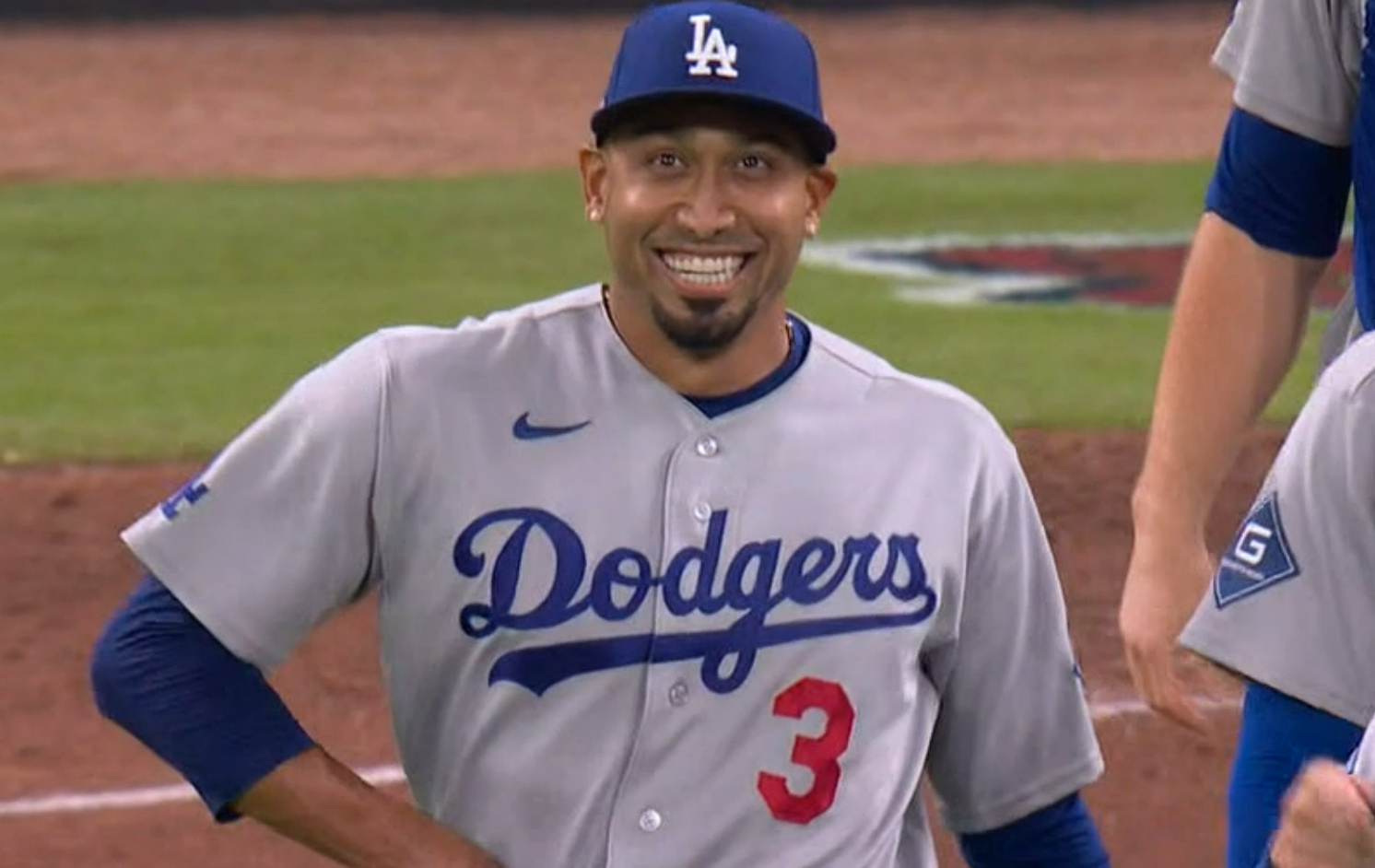
Edwin Diaz might be all the way back
Before the playoffs I wrote a post about Diaz’s improvement after returning in September, highlighted the real changes, and wondered if the Dodgers could trust him in that small sample size.
The result?
It took one playoff appearance before Dave Roberts installed him as closer.
A collection of pitches from probably the best Diaz has looked all year, where FS1 only had good shots for like two of them live. pic.twitter.com/4cB89ZiBmB
— Chad Moriyama (@ChadMoriyama) October 5, 2026
And he has been lights out.
His fastball is now sitting 98-100 MPH, and most importantly the command is there, and the increase in competitive pitches has increased the amount of chases he’s seen.
Diaz basically looks like the closer they paid for since September, and the timing couldn’t be better.
Kyle Tucker & Teoscar Hernandez are taking their Septembers into October
After rough seasons for both players that saw them on the verge of being replacement level, both Teoscar (.341/.420/.545/.965, 166 wRC+) and Tucker (.262/.354/.536/.889, 140 wRC+) had big September showings that gave some hope that they were turning things around just in time.
Indeed, both had big moments in the NLDS. Tucker led the team in hits with five in 15 at-bats, walking once, striking out three times, and stealing two bases. An emphatic homer as well.
LONG GONE ?
— MLB (@MLB) October 3, 2026
Kyle Tucker sends this 2-run homer 408 feet! pic.twitter.com/d8PxcSl0kA
A .364 xwOBA in September and a .408 mark in the DS.
Teoscar went 3-for-16 including some ugly strikeouts among his six, but he had a massive homer and just missed at least one other. He mostly was unlucky rather than bad, at least when he made contact, posting a .380 xwOBA not unlike his .401 mark in September.
TEOSCAR HERNÁNDEZ LEAVES THE YARD! pic.twitter.com/fPkgA1xwKz
— MLB (@MLB) October 3, 2026
In an environment where offense is at a premium, the Dodgers now being able to rely on them to be legitimate threats instead of free outs becomes huge for the constant pressure the put on opposing pitchers. The lineup lengthens and there’s no real free path or easy innings anymore. If they can keep it up, it’s a matter of time before a big inning or two.
This postseason might just be a bloodbath … for hitters
A lot of complaints about the team so far has revolved around the offense, understandable since the pitching staff has given up just eight runs in 36 innings for a 2 ERA, and they lead the DS with a 2.60 xERA.
By contrast, the bats have admittedly struggled to a .203/.264/.391/.655 line with a 79 wRC+. Thing is, that ranks them second out of the eight teams in the Division Series, and teams not the Dodgers have put up a collective .187/.280/.283/.563 line with a 62 wRC+. Pitching just might be that good this time of year, especially with managers being more aggressive in turning to their elite relievers whenever trouble approaches.
With that framing, the Dodgers scoring on a lot of homers is more of a positive than anything, as stringing rallies together will become increasingly difficult. And with the lineup showing increased length due to the aforementioned emergence of hitters in September and October, it gives them a better shot to do the bare minimum and scratch across runs.
It also becomes more important than ever that they work difficult at-bats and make pitchers work, as that doesn’t only pay dividends in terms of trying to score in one game or the other, but it wanes the effectiveness of relievers both in fatigue and getting multiple looks at them. They’re better positioned to do that than they have been all season is the point.
======
All that said, it’s hard to tell a ton from four games at the end of the day, but some times analyzing the minutiae can provide both interesting things to watch going forward and insight into where the future series will be won.
